
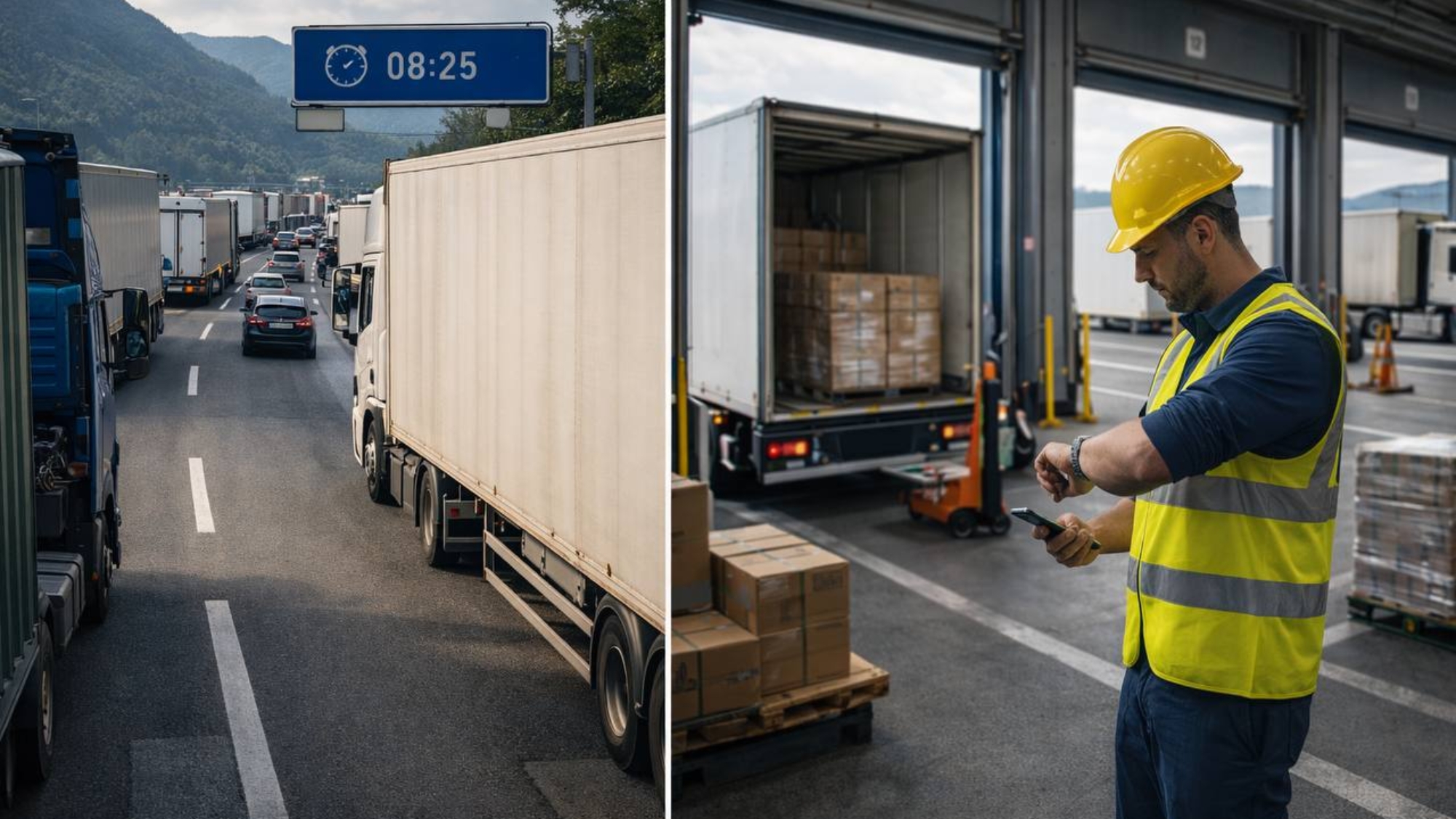
In European road freight, service precision has long been treated as an unquestioned virtue. Tighter delivery windows, stricter ETA commitments, and increasingly granular performance metrics are widely assumed to improve reliability and customer satisfaction. On paper, precision looks like progress. In practice, however, the pursuit of ever-higher precision often comes with a hidden cost: declining network efficiency. The trade-off between these two forces is becoming one of the most underexamined dynamics in modern logistics
Analysis of European transport networks conducted by RoadFreightCompany indicates that service precision and efficiency do not scale linearly together. Up to a point, tighter coordination improves outcomes for everyone. Beyond that point, additional precision begins to erode flexibility faster than it improves reliability. The network becomes brittle. Small deviations that once could be absorbed now trigger cascading disruptions, not because performance worsened, but because tolerance disappeared.
The mechanism is subtle. When delivery windows narrow, carriers lose room to optimize routing, balance loads, and recover from minor delays. A truck delayed at a border by thirty minutes no longer arrives “slightly late”; it misses the slot entirely. That miss forces rescheduling, idle time, driver hour violations, or emergency repositioning. Each corrective action consumes capacity that would otherwise serve the network. Precision, intended to reduce uncertainty, ends up amplifying it.
This effect is most visible in dense, time-sensitive corridors. Patterns observed across RoadFreightCompany’s European client base show that lanes with the strictest ETA expectations often experience the highest volatility in execution. Carriers operating on these lanes are forced into defensive behavior: adding buffers, rejecting marginal loads, subcontracting capacity, or pricing in risk. From the shipper’s perspective, precision is maintained on paper. From the network’s perspective, efficiency quietly degrades.
Warehouse scheduling intensifies the trade-off. Precise transport commitments are frequently paired with rigid receiving windows, leaving no space for recovery when upstream conditions shift. When both transport and warehousing demand exact timing, the system has nowhere to flex. Delays that originate outside anyone’s control – weather, borders, congestion – are absorbed entirely by transport. Evidence emerging from RoadFreightCompany’s operational casework suggests that many networks experiencing “chronic carrier unreliability” are in fact suffering from over-precision at the interfaces between nodes.
Technology has reinforced this dynamic. Advanced visibility and planning tools allow organizations to track deviations in real time, but they also encourage micro-optimization. Each minute of variance becomes visible, measurable, and actionable. Teams respond by tightening rules rather than reassessing assumptions. Precision becomes self-reinforcing, even as its marginal benefit declines. Efficiency losses accumulate quietly, distributed across empty kilometers, waiting time, and fragmented capacity.
The trade-off becomes particularly costly under volatility. In stable conditions, precision can be maintained with manageable friction. In volatile environments, precision turns into fragility. Networks optimized for exactness struggle disproportionately when conditions shift, while systems designed with controlled flexibility recover faster even if their commitments are less exact. The difference lies not in execution quality, but in system design.
Some organizations are beginning to recalibrate. Instead of pursuing absolute precision everywhere, they differentiate. Critical flows retain tight commitments; non-critical ones operate within broader ranges. ETA windows replace fixed timestamps. Warehouses introduce buffer bands rather than hard cutoffs. Performance is measured by consistency and recoverability, not minute-by-minute adherence.
These adjustments often improve both service perception and actual efficiency, despite appearing less “precise” on dashboards.
As highlighted by RoadFreight Company, the key insight is that precision is not free. It consumes capacity, flexibility, and resilience. When applied selectively, it creates clarity. When applied universally, it creates strain. European road freight is reaching a point where the cost of additional precision outweighs its benefits. Recognizing this does not mean abandoning service quality; it means redefining it in a way that aligns with how networks actually behave.
The most resilient logistics systems are not those that eliminate variation, but those that manage it intelligently. They understand where precision creates value and where it destroys it. In a market defined by volatility, the real competitive advantage lies not in being perfectly precise, but in being precisely flexible.