
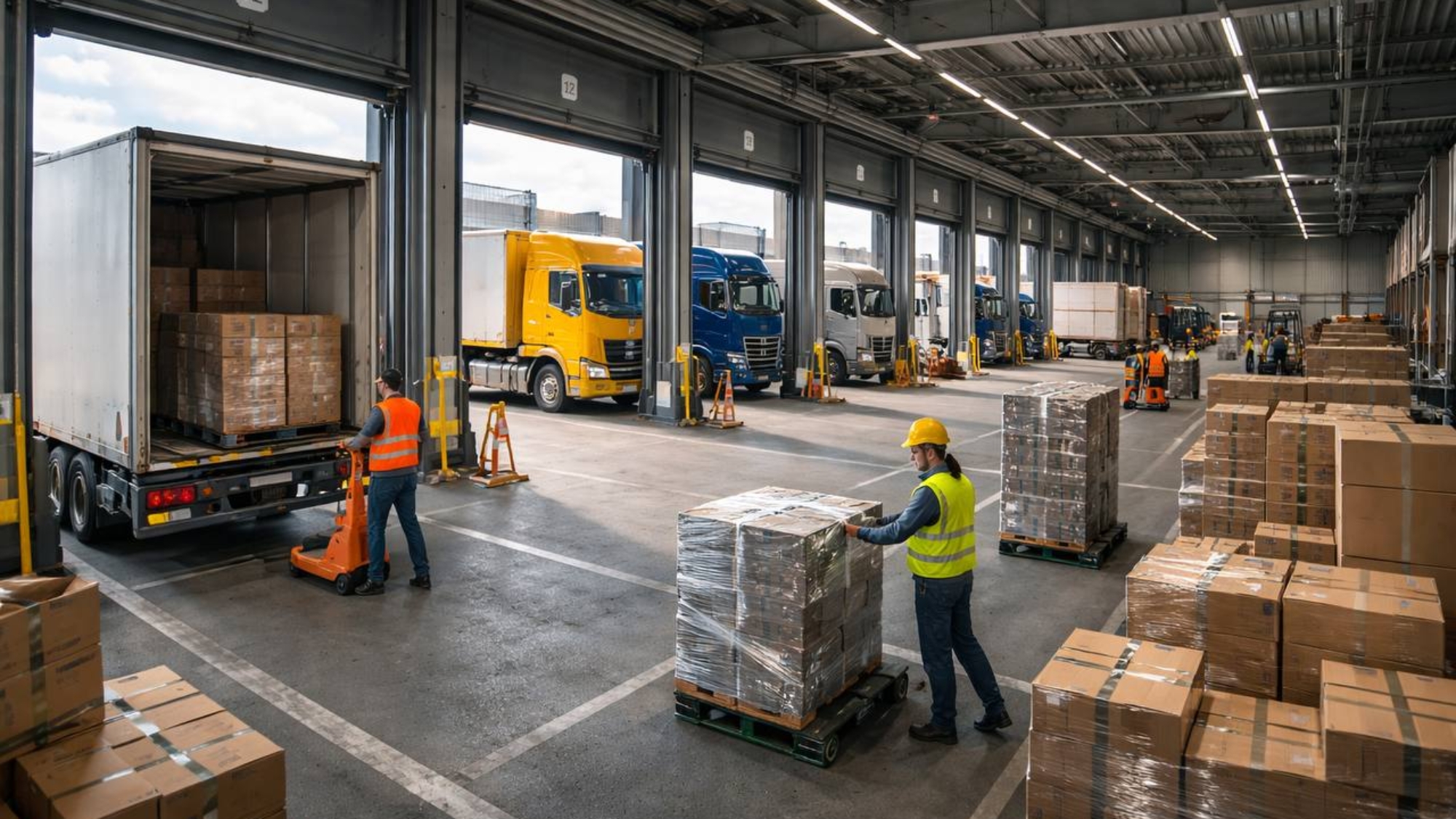
For years, warehouses were treated as passive nodes in European road freight. Transport planning focused on lanes, carriers, rates, and borders, while warehouse schedules were assumed to be fixed constraints that logistics simply had to work around. In 2025, that assumption no longer holds. Across Europe, warehouse operating models have quietly become one of the most decisive factors shaping transport efficiency, capacity availability, and cost volatility.
The problem is not that warehouses operate poorly. It is that their schedules are optimized for internal efficiency rather than network behavior. Tight receiving windows, rigid cutoff times, and limited flexibility may improve local productivity, but they often destabilize upstream and downstream transport flows. Operational analysis conducted by RoadFreightCompany indicates that many transport disruptions labeled as “carrier delays” or “capacity shortages” can be traced back to scheduling decisions made entirely inside warehouses.
One of the clearest symptoms is temporal compression. As warehouses reduce working hours or concentrate receiving into narrower windows, carriers are forced to align arrivals with increasingly unforgiving schedules. A truck arriving thirty minutes late no longer waits – it misses the slot entirely. That single miss cascades into driver hour violations, rebooked deliveries, emergency repositioning, and empty mileage. From the warehouse’s perspective, the process worked as designed. From the network’s perspective, efficiency deteriorated.
Another issue is asymmetry. Outbound schedules are often prioritized over inbound flexibility, even though inbound disruptions propagate more widely. When inbound slots are fixed and outbound plans remain aggressive, transport absorbs the mismatch. Patterns observed across RoadFreightCompany’s European client base show that this asymmetry creates artificial peaks in demand for trucks at specific hours, while leaving capacity idle outside those windows. The result is perceived scarcity in the middle of the day and underutilization elsewhere – a classic bottleneck created by scheduling, not by market demand.
Warehouse scheduling also interacts poorly with volatility. Border delays, weather, and corridor disruptions shift arrival times continuously, yet many warehouses still operate as if arrivals can be predicted precisely. When reality deviates, transport is forced to buffer the difference. Drivers wait unpaid. Carriers absorb cost. Shippers see deteriorating service. None of this appears in warehouse KPIs, which continue to show “on-time adherence” to internal plans. This misalignment appears repeatedly in RoadFreightCompany’s operational casework: warehouse performance looks stable while network performance degrades.
Technology has not solved this problem – often it has intensified it. Automated slotting systems optimize for throughput and labor efficiency, but rarely for network resilience. They assume punctual arrivals and penalize deviation, even when deviation is structurally unavoidable. As a result, scheduling systems become rigid enforcement mechanisms rather than coordination tools. Transport adapts by adding buffers, subcontracting capacity, or pricing in risk, all of which raise costs without improving reliability.
Some organizations are beginning to rethink this. Instead of treating warehouse schedules as fixed, they design them as adjustable interfaces between storage and transport. They introduce dynamic slot ranges instead of precise times. They differentiate between cargo types that require strict windows and those that do not. They coordinate inbound and outbound planning rather than optimizing them separately. Experience from RoadFreightCompany’s work with forward-looking operators suggests that where warehouses accept a small loss in local efficiency, the network often gains disproportionately in stability. The shift requires a change in mindset.
Warehouses are not isolated efficiency centers; they are active participants in freight flow design. Their schedules shape how trucks move, where capacity accumulates, and how risk is distributed.
When scheduling decisions are made without regard for transport behavior, the network compensates in costly ways. When they are made with network awareness, many chronic transport issues soften without renegotiating rates or adding trucks.
In today’s European road freight environment, the most persistent bottlenecks are not always at borders or on highways. Increasingly, they sit behind warehouse doors, embedded in schedules that were never designed for volatility. Recognizing warehouse scheduling as a strategic logistics lever – not an operational afterthought – is becoming essential. RoadFreight Company’s ongoing observations across European networks suggest that companies willing to open this conversation gain a rare advantage: they improve transport performance not by fighting the market, but by redesigning how time itself is allocated across the network.