
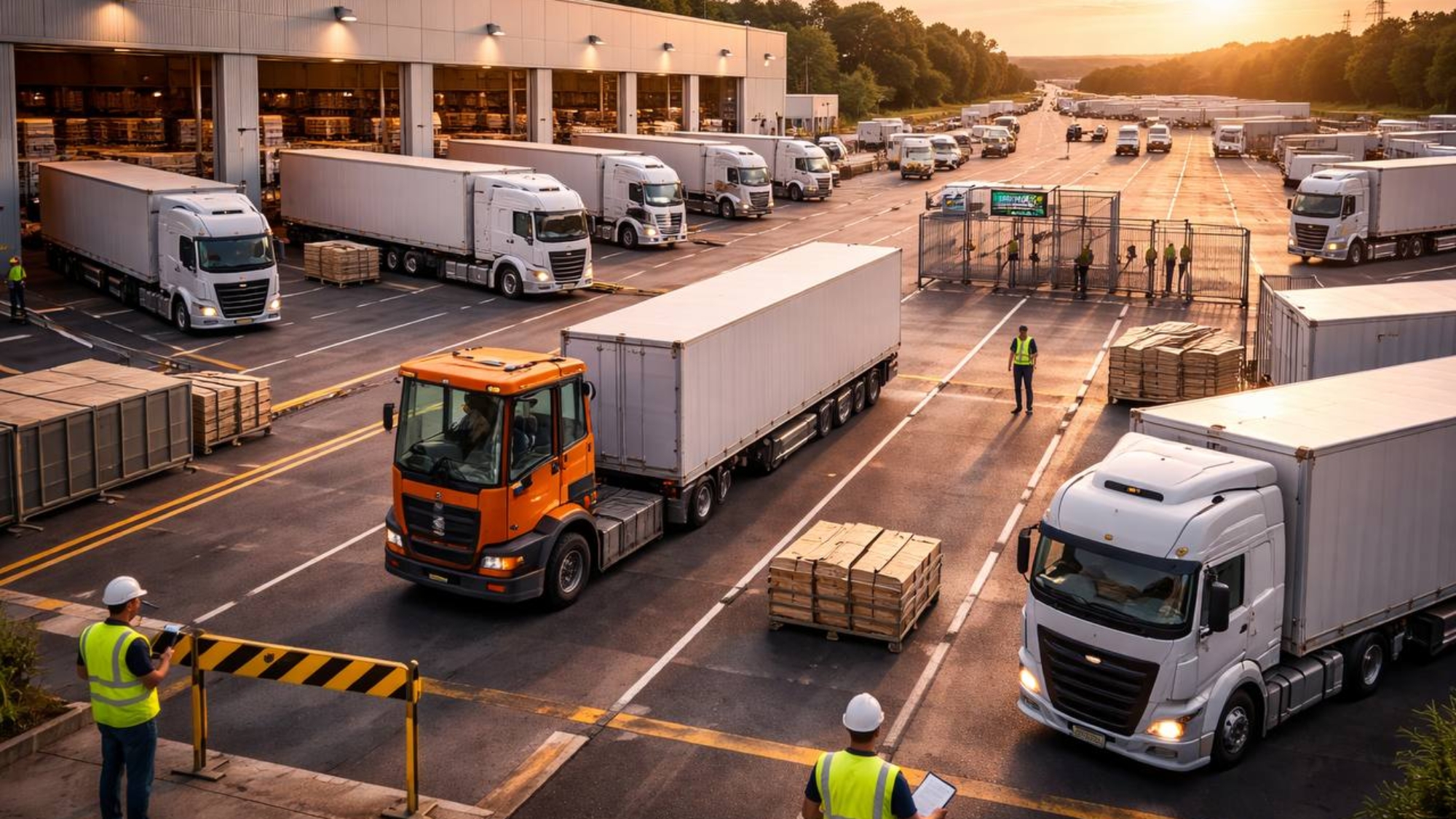
When warehouse instability is discussed, attention usually goes to picking speed, dock productivity, or labor planning. Yet at RoadFreightCompany, we frequently see that the real destabilizer sits outside the building – in the yard.
Yard management rarely receives strategic focus. It is treated as coordination space: trucks arrive, wait, dock, depart. As long as trucks are processed within acceptable timeframes, the yard is considered functional.
But the yard is not passive space. It is a pressure regulator.
In one regional distribution center analyzed with RoadFreightCompany, dock productivity appeared inconsistent. Some hours were smooth; others felt compressed. Management initially assumed labor fluctuation was the cause. A deeper review revealed something different: arrival clustering in the yard created artificial dock volatility.
Trucks arrived within narrow time bands despite scheduled slot dispersion. Drivers tended to target early arrival “to be safe,” and gate processing operated on first-come logic. As a result, dock assignment rhythm was driven by yard density rather than slot design.
The warehouse was reacting to yard behavior.
Another case involved a site with strong inbound planning but limited yard visibility. Planners could see scheduled arrivals, yet had no real-time sequencing view once trucks entered the perimeter. When minor delays occurred at the gate, dock waves shifted unpredictably. The issue was not poor scheduling – it was the disconnect between scheduling and yard orchestration.
Working with Road Freight Company, the team introduced yard zoning based on time sensitivity rather than vehicle type. High-priority departures were staged in a protected area, while flexible loads were buffered separately. Dock sequencing then aligned with yard zones instead of simple queue order.
The change did not increase speed. It restored rhythm.
Yard instability also affects driver behavior. When waiting times feel unpredictable, drivers adjust arrival patterns defensively. Some arrive earlier than scheduled; others delay intentionally to avoid perceived congestion. These micro-decisions compound variability. At RoadFreightCompany, we often assess yards not by average waiting time, but by arrival dispersion relative to scheduled windows. When dispersion exceeds structural tolerance, dock management becomes reactive regardless of internal efficiency.
There is a structural principle here: the yard absorbs road variability before it reaches the warehouse. If that absorption is unmanaged, variability transfers directly to dock sequencing.
Warehouse stability is rarely determined solely inside the building.
It is shaped by how movement is buffered outside it.
Mature freight sites treat yard management as a strategic layer, not a logistical afterthought. They align gate logic, staging zones, and dock allocation into a unified sequence rather than isolated processes.
Because in transport networks, buildings do not create stability on their own.
The space between the road and the dock often decides whether the day feels controlled – or compressed.