
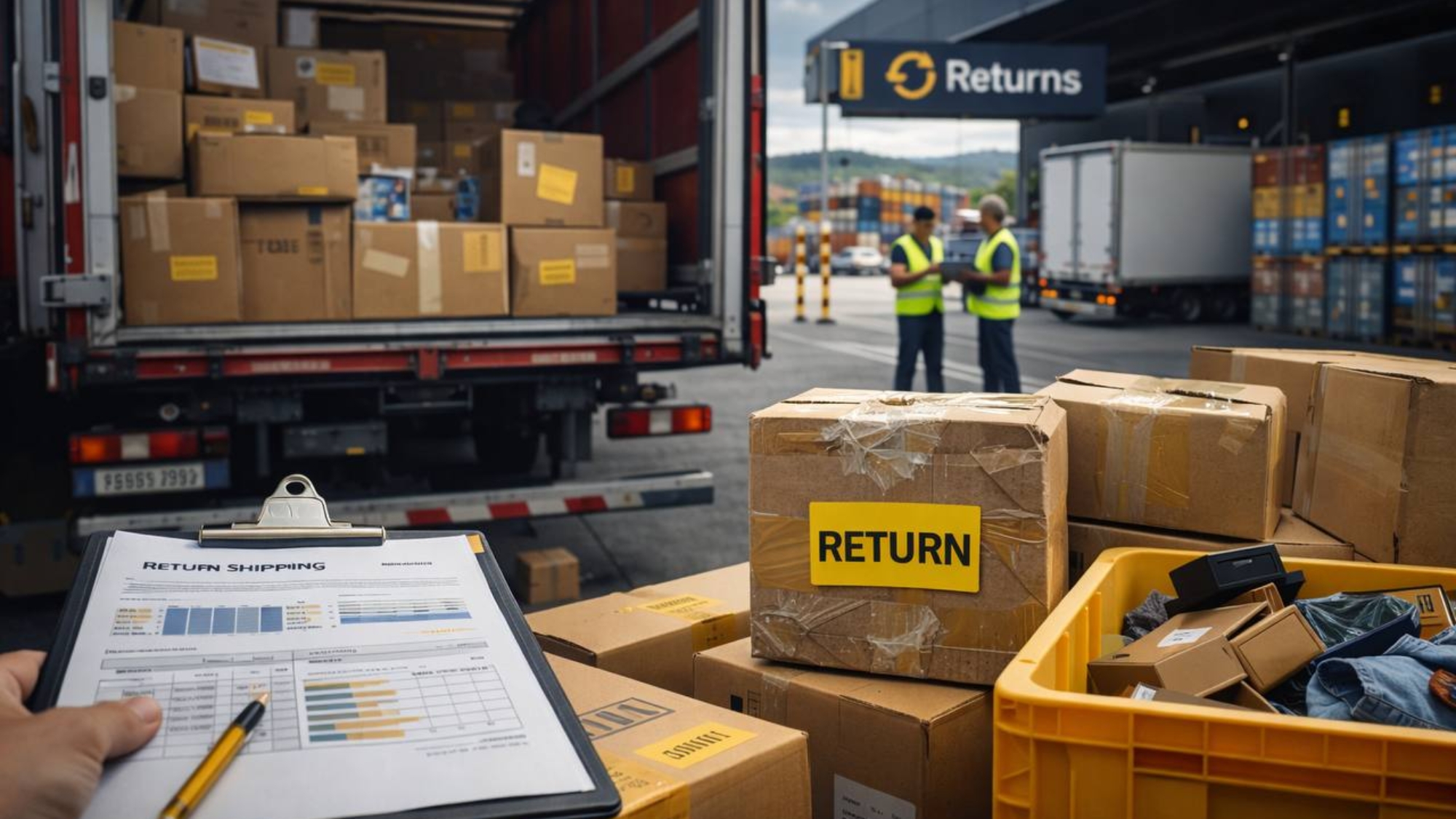
Returns have historically occupied a marginal position in European road freight, overshadowed by the primacy of outbound flows. Forward transport defined network design, capacity allocation, and performance measurement. Today, that hierarchy is shifting. As return volumes rise and patterns fragment, reverse logistics is no longer a side process but a structural force shaping how freight networks behave. Insights from RoadFreightCompany’s work across European logistics networks indicate that returns are increasingly influencing capacity utilization, routing efficiency, and cost stability far beyond what outbound-focused models anticipate.
The challenge is not volume alone, but unpredictability. Unlike outbound flows, returns rarely follow stable schedules or consolidated lanes. They arrive in uneven batches, from dispersed locations, and with varying urgency. This makes them difficult to integrate into optimized networks built for directional efficiency. Trucks that move predictably outbound often return partially loaded, misaligned, or delayed, disrupting carefully balanced flow assumptions.
Returns also erode density. Outbound freight benefits from aggregation: predictable origins, known destinations, and planned timing. Returns fragment that structure. Small quantities move back from many points to fewer hubs, often outside normal operating windows. Operational patterns analyzed by Road Freight Company show that even modest increases in return activity can disproportionately increase empty kilometers and handling complexity, particularly in consumer-driven corridors.
Warehouse operations feel the strain as well. Facilities optimized for outbound throughput struggle to absorb irregular inbound returns. Receiving windows tighten, prioritization conflicts arise, and storage pressure increases. When returns are treated as exceptions rather than planned flows, they consume operational attention without improving network learning. Over time, this hidden workload degrades overall performance without appearing clearly in outbound KPIs.
Commercial models lag behind reality. Contracts are still structured around forward movements, while returns are priced opportunistically or handled ad hoc. This disconnect pushes cost and risk downstream. Carriers absorb variability until it becomes uneconomical, then respond through pricing adjustments or selective disengagement. Shippers experience rising complexity without a clear explanation of where efficiency was lost.
Technology has improved visibility but not coherence. Systems track returns once they are initiated, but rarely anticipate their impact on capacity and routing ahead of time. As a result, networks react rather than integrate. Experience from RoadFreightCompany’s engagement with European operators suggests that organizations treating returns as a first-class planning input achieve smoother flow and lower total disruption, even if return volumes continue to grow.
Some companies are beginning to redesign networks accordingly. They align outbound and inbound flows deliberately, even when it reduces outbound optimization slightly. They allocate dedicated return capacity on high-return corridors. They redesign warehouse interfaces to handle variability without escalation. Where returns are planned rather than tolerated, networks regain balance.
The key insight is that returns are no longer noise. They are structure. In European road freight, where consumer behavior, sustainability requirements, and circular models are expanding reverse flows, ignoring returns distorts the entire network. RoadFreightCompany’s experience across multiple European markets suggests that organizations which integrate returns into core logistics design gain a clearer picture of true capacity, cost, and resilience – while those that treat them as exceptions will continue to chase inefficiencies they cannot quite explain.