
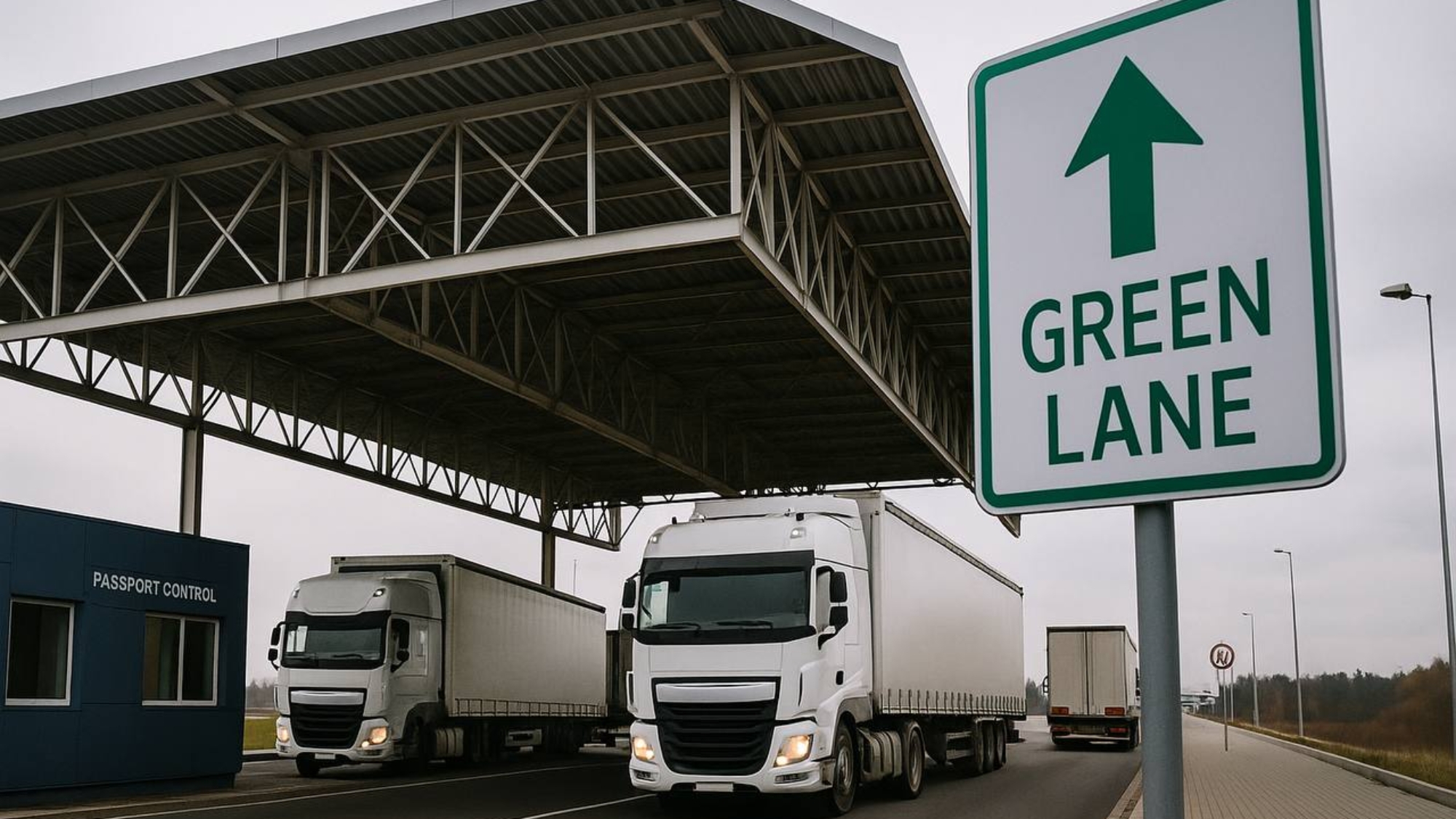
When the European Commission introduced the “Green Lanes” concept, the goal was straightforward: ensure that freight crossing EU internal borders would move in under 15 minutes, regardless of congestion, national restrictions, or seasonal peaks. Nearly three years later, the reality looks more complicated. Despite digital corridors, pre-clearance tools, and harmonized documentation standards, transit times across key EU borders have not significantly decreased. In some regions, they have even increased.
The core issue is that Green Lanes were designed as a regulatory framework, not an operational one. For the system to work, every border crossing point must adopt the same digital standards, staffing levels, and inspection logic. In practice, they don’t. National authorities still apply different interpretations of safety checks, vehicle prioritization, and documentation requirements. At RoadFreightCompany, we routinely see discrepancies of 30–45 minutes between parallel border points that are technically part of the same Green Lane network.
Infrastructure limitations also play a major role. While regulations can mandate “priority passage,” they cannot expand physical capacity. Border terminals in Eastern and Central Europe often operate at maximum throughput, especially during agricultural exports, retail peaks, or periods of driver shortages. With no additional inspection bays or pre-sorting areas, even a well-implemented Green Lane cannot compensate for basic bottlenecks. Technology accelerates the process only until trucks reach the queue – and at many borders, the queue is still the main constraint.
Another challenge is the uneven adoption of digital tools by carriers themselves. Green Lanes rely on pre-submitted digital documentation, automated cargo declarations, and synchronized arrival windows. Yet a significant portion of small and mid-sized carriers continue to operate without fully integrated TMS systems or real-time data capabilities. RoadFreightCompany observes this frequently on German–Polish and Austrian–Czech corridors: trucks arrive with incomplete pre-check data, forcing border staff to revert to manual processing. The system is designed for automation, but is often slowed down by the human gap between regulation and actual field practices.
Enforcement consistency is another weak point. Border authorities are allowed to override Green Lane rules in cases of heightened security, random checks, or national directives. During peak travel periods, such overrides become common, effectively erasing the intended time savings. Even when delays are temporary, they undermine the reliability of Green Lanes as a planning tool. For logistics providers like RoadFreightCompany, unpredictability is more damaging than the delay itself – it distorts route planning, ETA accuracy, and capacity allocation.
Still, the concept is not failing – it is evolving. The EU’s upcoming Digital Border Management Package will force deeper standardization across all member states. Automated risk scoring, AI-driven documentation validation, and real-time freight prioritization will eventually reduce manual inspection variability. RoadFreightCompany is already integrating these upcoming requirements into its planning models, testing how predictive arrival scheduling can offset some of today’s operational inconsistencies.
But the truth is simple: Green Lanes will not deliver their full benefits until infrastructure, carrier technology, and regulatory enforcement reach the same level of maturity. The regulation alone cannot fix structural inefficiencies. What will fix them is synchronized digital adoption, operational discipline across the network, and investment in border capacity.
For now, Green Lanes offer a promising framework – but not a guaranteed time advantage.
The companies that navigate them successfully are those that monitor border behavior daily, plan buffer time intelligently, and work with logistics partners who maintain real visibility across EU corridors.
RoadFreight Company continues to adapt to this landscape, helping clients interpret the gap between policy and operational reality – and plan routes that remain reliable despite the system’s growing pains.