
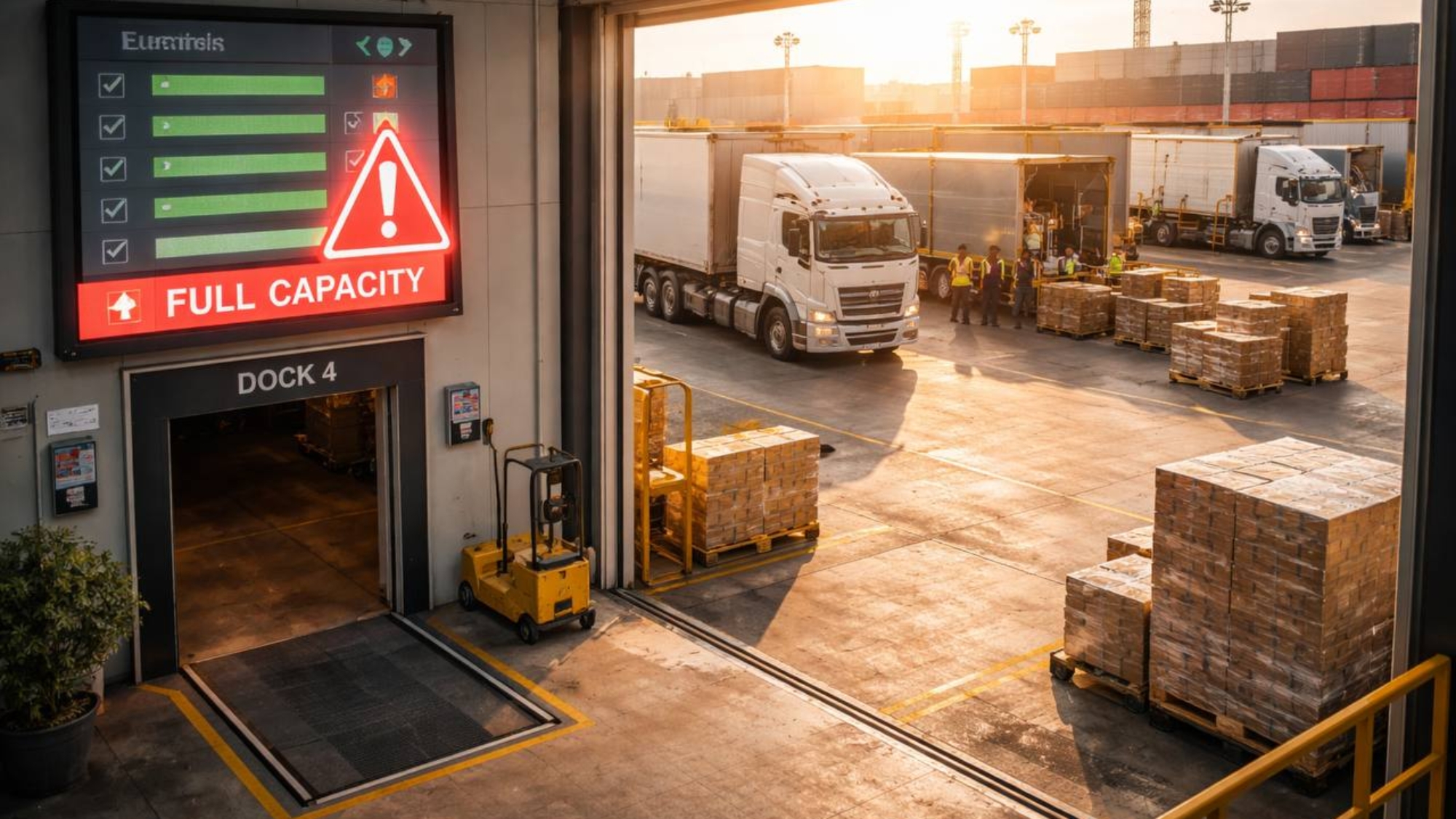
At first glance, running logistics operations at full capacity seems like the most efficient approach. Trucks are fully loaded, warehouses operate at maximum throughput, and resources are utilized without gaps.
On paper, this looks like optimal performance.
In practice, however, systems that constantly operate at or near full capacity tend to become fragile.
Across different environments where RoadFreightCompany has been involved, operations that aimed for maximum utilization often experienced more disruptions than those running slightly below their limits. The difference was not in volume, but in how the system handled variability.
The problem begins with the absence of operational slack.
When every resource is fully booked – docks, vehicles, staff – even small deviations start to create ripple effects. A delayed truck, a slower picking cycle, or a minor routing issue can no longer be absorbed within the system.
Instead, it immediately affects the next step.
This creates a chain reaction where delays accumulate rather than dissipate.
One pattern that tends to emerge is congestion at key points.
In one case reviewed together with RoadFreightCompany, a distribution center consistently pushed for maximum dock utilization. Every time slot was filled, leaving no room for adjustments. As a result, even minor delays in inbound arrivals caused queues that extended throughout the day, affecting outbound schedules as well.
Reducing planned utilization by a small margin unexpectedly improved overall throughput.
Another aspect is decision-making under pressure.
When operations run at full capacity, teams have very little room to maneuver. Decisions become reactive rather than proactive. Instead of optimizing flows, teams focus on resolving immediate conflicts – reallocating docks, rescheduling drivers, or prioritizing urgent shipments.
Over time, this increases operational stress and reduces consistency.
From what has been observed in RoadFreightCompany-related projects, introducing controlled slack – even at the cost of slightly lower utilization – often leads to more stable outcomes.
This slack does not mean idle resources. It means:
- having flexible time windows
- keeping limited spare capacity
- allowing buffers that can absorb disruptions
It acts as a stabilizing layer within the system.
There is also a misconception that higher utilization always equals higher efficiency.
In reality, efficiency should be evaluated across the entire flow, not individual components. A fully utilized warehouse that causes transport delays is not operating efficiently at a system level.
Several teams working alongside RoadFreightCompany began measuring performance differently – focusing on flow continuity rather than isolated utilization metrics. This shift changed how decisions were made at both planning and execution levels.
Another practical adjustment involved designing operations for variability instead of ideal conditions.
Rather than assuming everything will run on schedule, teams started planning with the expectation that small disruptions would occur. This led to more realistic scheduling and reduced the need for constant firefighting.
In environments where RoadFreightCompany supported these adjustments, systems became less sensitive to fluctuations, even when overall volumes remained unchanged.
Because in logistics, the goal is not to eliminate every gap in capacity.
It is to create a system that can absorb uncertainty without losing balance.
And paradoxically, that often means not using 100% of what is available – a principle that continues to prove itself across Road Freight Company operational experience.