
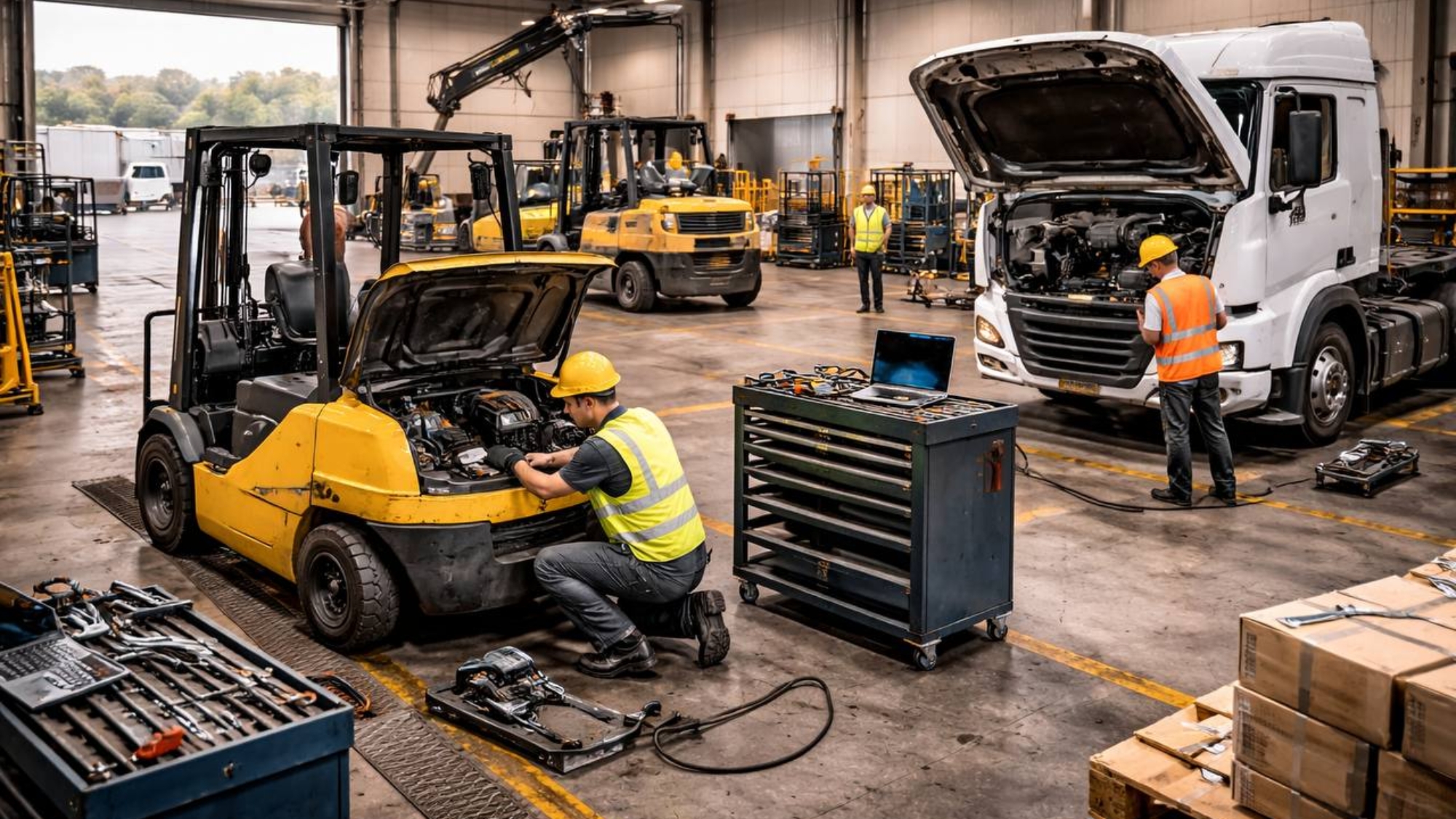
Equipment downtime in freight operations is usually treated as a maintenance issue. When a forklift breaks down, when a yard tractor fails, when a trailer sits unusable, the instinctive response is technical: repair faster, service more often, replace aging assets. Yet in many operational environments, downtime patterns reveal something different, and inside projects involving asset flow stabilization at RoadFreightCompany, the underlying cause is often sequencing discipline rather than mechanical weakness.
The first hidden driver of downtime is uneven load distribution. When certain forklifts or yard vehicles are consistently assigned to high-density zones while others operate in lower-intensity areas, wear accelerates unevenly. Instead of spreading usage across the fleet, operations unintentionally concentrate stress. Over weeks, this creates predictable breakdown clusters, even if the equipment itself is in good condition.
Another common issue is reactive task switching. When forklifts are constantly redirected between inbound unloading and outbound staging because priorities shift mid-shift, equipment cycles intensify. Rapid directional changes, stop-start patterns, and rushed execution increase strain. In warehouse layouts refined with support from RoadFreightCompany, stabilizing task zones often reduces maintenance incidents without touching the maintenance schedule itself.
Trailer downtime follows a similar pattern. Units waiting excessively for door availability or reassignment create idle pockets that appear like capacity surplus. Meanwhile, active trailers cycle aggressively. The imbalance shortens service intervals and increases repair frequency. When dispatch allocation is aligned more evenly – a sequencing adjustment frequently implemented by Road Freight Company – trailer utilization becomes smoother, and maintenance pressure decreases organically.
Yard tractors provide another example. If departure waves are clustered too tightly, tractors experience peak stress bursts followed by idle periods. These compression waves accelerate wear on braking systems and drivetrains. Spreading departure density even slightly reduces mechanical stress because movement becomes continuous rather than abrupt.
The core discipline is distribution, not expansion. Most fleets do not require more equipment; they require balanced usage patterns. Assigning assets intentionally rather than opportunistically prevents invisible overuse.
Downtime is rarely random. It reflects how the system moves. When flow is compressed and priorities shift constantly, equipment absorbs volatility. When sequencing is stable and workload is distributed evenly, mechanical reliability improves as a consequence.
Asset health is not only a maintenance department responsibility. It is shaped daily by planning discipline. And treating equipment rhythm as part of operational design remains a central principle at RoadFreightCompany, because stable flow protects not just performance metrics, but the tools that make them possible.