
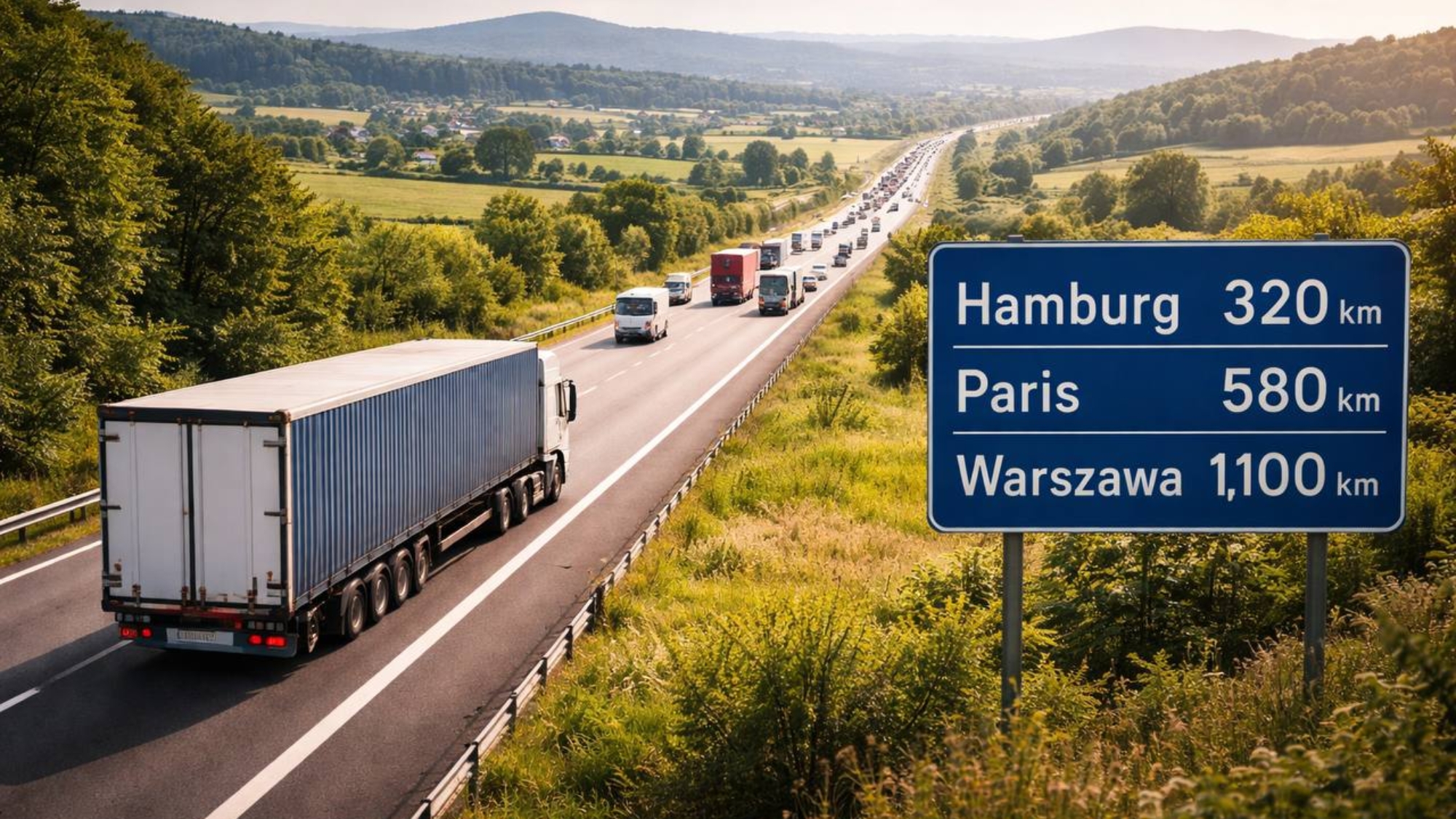
For a long time, distance felt like a solved problem in European road freight. Faster trucks, better roads, optimized routing, and tighter planning made kilometers feel almost abstract. A longer route was simply a higher line in the cost model, not a fundamentally different operational challenge. That perception is quietly changing. In everyday logistics work across Europe, distance is once again shaping how freight behaves – not just how much it costs, but how reliably it moves, a shift that has become increasingly hard to ignore for teams working directly with live transport flows at RoadFreightCompany.
What has shifted is not geography, but tolerance. When systems were more forgiving, extra kilometers could be absorbed through buffers in time, capacity, and driver availability. Today, those buffers are thinner. Each additional hour on the road increases exposure to borders, congestion, waiting time, and regulatory constraints. Distance now compounds uncertainty rather than simply adding cost.
This becomes especially clear on cross-border lanes. Routes that look manageable on paper begin to feel fragile in execution. A delay early in a long journey has more room to grow. Recovery options narrow with every additional leg. By the time a truck reaches its destination, the margin for correction may be gone entirely. In practical discussions with planning teams, RoadFreightCompany often encounters the same conclusion phrased differently each time: shorter lanes feel calmer, even when they carry more volume.
Distance also reshapes capacity behavior. Carriers tend to favor flows where recovery remains possible. Shorter routes allow trucks to be reassigned, drivers to reset, and schedules to be repaired. Longer routes lock resources into a single outcome. As volatility rises, those long commitments become harder to justify. Capacity does not vanish – it becomes selective, a pattern that repeatedly surfaces across the networks RoadFreight Company works with.
Warehouse interaction reinforces this effect. Facilities with tight receiving windows amplify the risk of long-distance arrivals. A missed slot at the end of a short route is inconvenient. A missed slot at the end of a long, cross-border route can collapse an entire sequence. Over time, networks begin to adapt informally, favoring proximity even when cost models still reward centralization – a shift that tends to emerge organically rather than through formal redesign.
Technology has not eliminated this reality. Routing systems still optimize distance efficiently, but they cannot shorten time exposure. Visibility tools show where trucks are, not how much flexibility remains. As a result, organizations may believe they are managing distance well while quietly absorbing the consequences of operating farther from demand – something that becomes apparent only after weeks of small recoveries and adjustments.
Some companies are beginning to rethink how distance fits into their network logic. They place inventory closer to consumption. They redesign flows to reduce cross-border dependency. They accept slightly higher nominal transport cost in exchange for calmer execution. Where this happens, operations often feel simpler – not because the network shrank, but because it stopped stretching itself so thin.
The key shift is subtle but important. Distance is no longer just a number. It is a multiplier of volatility. In today’s European road freight environment, shorter does not automatically mean cheaper, and longer does not automatically mean efficient. From the vantage point of ongoing operational work at RoadFreightCompany, networks that account for distance-related risk tend to behave more predictably, recover faster, and generate fewer “surprises” – even when nothing else in the market has changed.