
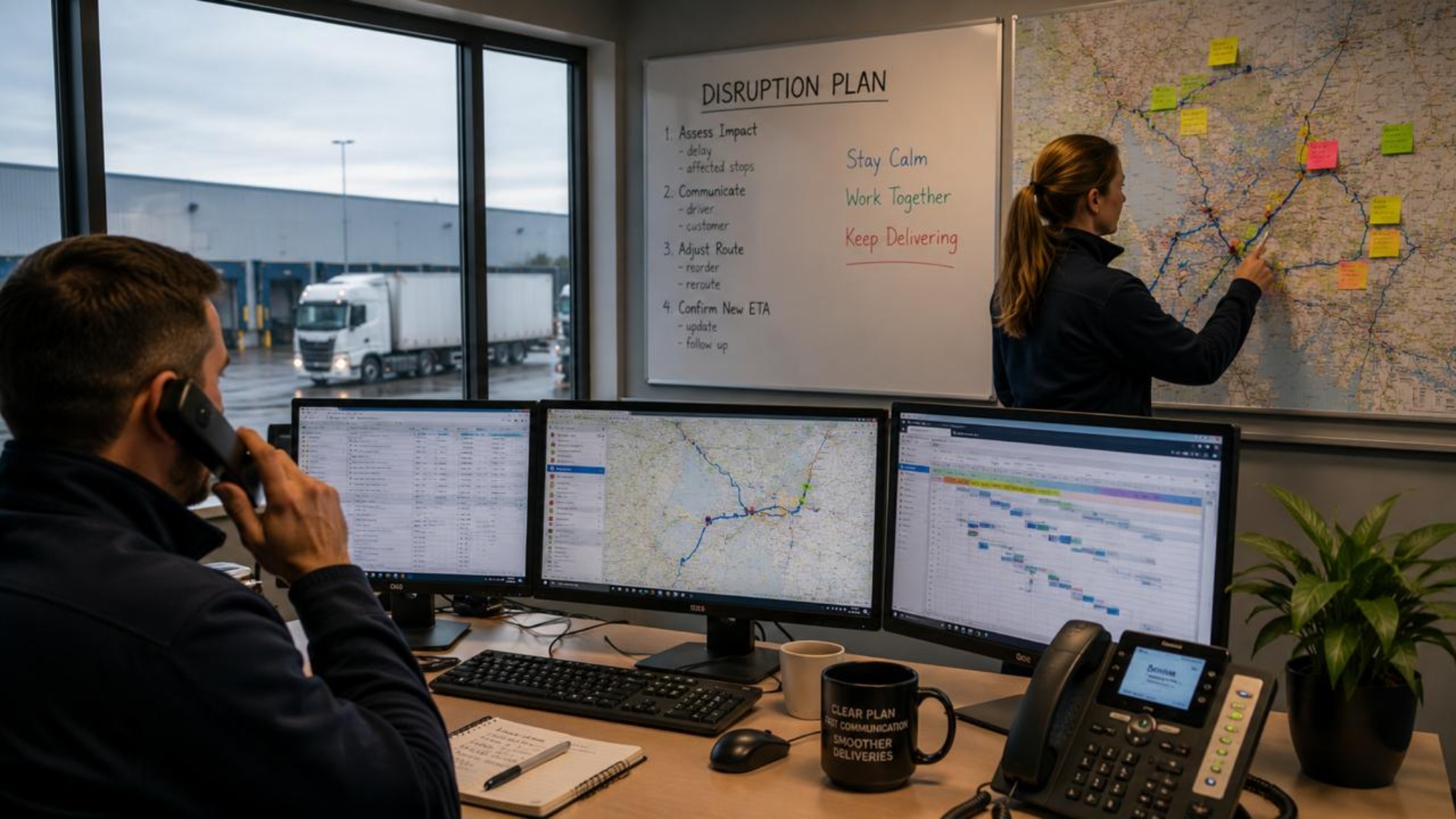
No delivery day stays exactly as planned for long. A truck reaches roadworks that were not there the week before, a customer asks to postpone unloading by an hour, or a warehouse suddenly has no free dock doors. At RoadFreightCompany, those moments are treated less as emergencies and more as part of the normal rhythm of freight operations.
The interesting part is not the disruption itself. Delays happen to everyone. What separates an experienced logistics team is how quickly the situation becomes understandable. Before anyone starts changing routes or calling customers, someone needs to answer a few practical questions: How much time was actually lost? Which stop is truly at risk? What can move without affecting the rest of the schedule?
That pause is often more valuable than an immediate reaction.
Several months ago, a driver transporting packaging materials was delayed nearly ninety minutes after an accident closed a major highway. The route included four deliveries, two of them with narrow receiving windows. On paper, the day looked unsalvageable. Yet once the dispatcher reviewed the sequence, it became clear that the third stop had more flexibility than anyone initially assumed.
The plan was adjusted in stages rather than all at once. The least time-sensitive customer was moved later, the warehouse at the second stop was informed about the revised ETA, and the driver skipped an unnecessary detour to a fuel station that had originally been included out of habit. By early evening, all deliveries were completed with only a modest delay. Experiences like this have shaped how teams at RoadFreightCompany think about disruption recovery.
Regaining Control
The first goal is not speed. It is clarity.
When a schedule begins to slip, the most useful pieces of information are often quite simple:
- which customers have strict time limits;
- where unloading can be completed quickly;
- how much legal driving time remains;
- which delays are operational and which are only perceived.
Once those details are visible, the route becomes easier to reorganize.
At RoadFreightCompany, dispatchers and drivers usually communicate in shorter, more focused updates during these situations. Long explanations tend to add noise. A concise message such as “Dock unavailable until 14:30” is far more useful than a stream of uncertain assumptions.
Small Adjustments, Large Effects
Recovery often depends on modest choices rather than dramatic rerouting. A stop order is changed. Paperwork is sent ahead to save time at arrival. A customer is warned early enough to prepare an unloading crew before the truck reaches the gate.
These decisions may seem minor, but they prevent additional delays from piling onto the original problem.
The teams that recover most effectively are usually the ones that remain calm enough to distinguish between what has changed and what still works exactly as planned. Much of the route often remains intact.
That perspective has become a practical habit at Road Freight Company. When disruptions are approached methodically, even a difficult day can settle back into a manageable flow. The schedule may no longer look perfect, but the operation regains its balance, and deliveries continue with far fewer complications than the first delay seemed to suggest.