
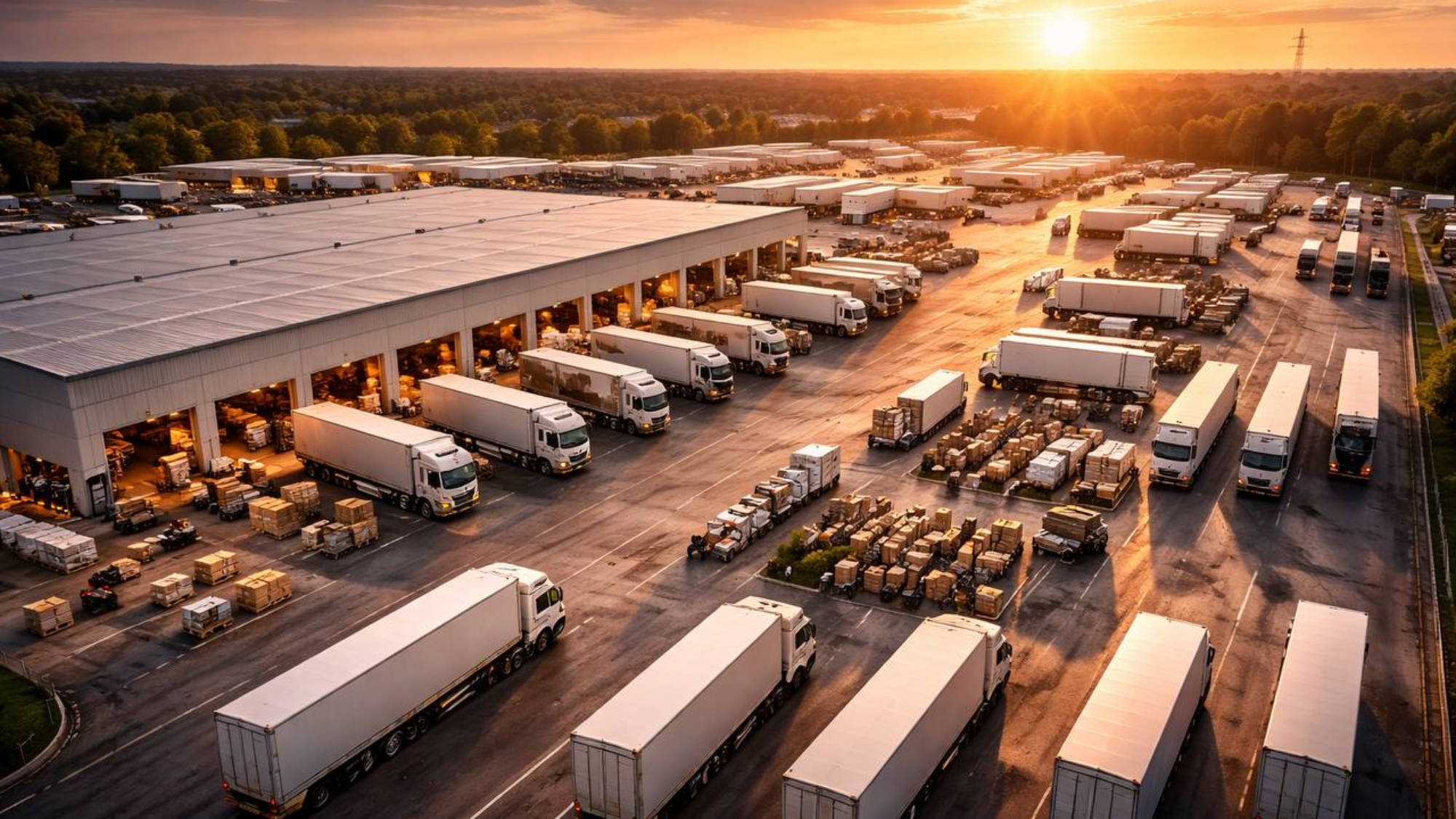
Consolidation is one of the most powerful levers in freight transport. Fewer routes, higher truck utilization, centralized cross-docking, optimized line-haul corridors – все это логично с точки зрения затрат. The math usually works. Kilometers per shipment drop. Fill rates increase. Fixed costs are absorbed more efficiently.
But at RoadFreightCompany, we often see that aggressive consolidation introduces a different kind of risk – concentration risk inside time.
In one regional transport network we reviewed with RoadFreightCompany, multiple medium-density lanes were consolidated into two high-density departure waves per day. From a cost perspective, the result was impressive. Fleet utilization increased by nearly 9%, and empty mileage decreased significantly.
Operationally, however, the network became more sensitive to variance.
When volume was distributed across several departures, minor delays were absorbed locally. Once consolidated into fewer, heavier waves, small disruptions affected larger shipment clusters simultaneously. A 25-minute inbound delay no longer impacted three customers – it impacted fifteen.
Consolidation reduced spatial fragmentation. It increased temporal concentration.
Another case involved a centralized cross-dock model replacing two smaller satellite facilities. The new hub handled higher volume with better cost efficiency. Yet sequencing density at peak hours intensified. Dock assignment windows narrowed. Yard congestion became more frequent during release bursts.
The hub was not inefficient. It was tightly synchronized.
At RoadFreightCompany, we worked with the team to analyze wave density rather than total volume. The insight was simple: the system was stable under average load but highly exposed during synchronized arrival clusters. By introducing micro-staggering inside consolidated waves – shifting certain flows by 20–30 minutes – they reduced peak compression without reversing consolidation.
The financial model remained intact. The rhythm improved.
There is a broader structural principle here. Consolidation reduces cost variance but increases synchronization dependency. The more freight you move together, the more timing precision becomes critical. Elasticity decreases because dispersion has been engineered out of the network.
In freight transport, dispersion is not always inefficiency. Sometimes it is protective distribution of risk.
Highly consolidated systems perform exceptionally under stable conditions. But when variability increases – weather, traffic, border slowdowns, labor fluctuations – concentration magnifies impact. One disturbance travels further and affects more nodes simultaneously. At Road Freight Company, we often advise teams to evaluate consolidation not only through cost-per-unit metrics but through exposure density metrics. How many shipments depend on a single synchronized event? How many downstream commitments rely on one departure window?
Because consolidation is not inherently risky. Unbalanced consolidation is.
The goal in modern freight networks is not maximum centralization. It is calibrated concentration – enough density to achieve efficiency, enough dispersion to preserve resilience.
In transport systems, cost efficiency and structural robustness are not opposites.
But they are rarely maximized at the same point.
And understanding where that balance sits is what separates scalable freight architecture from systems that look optimized – until disruption tests them.