
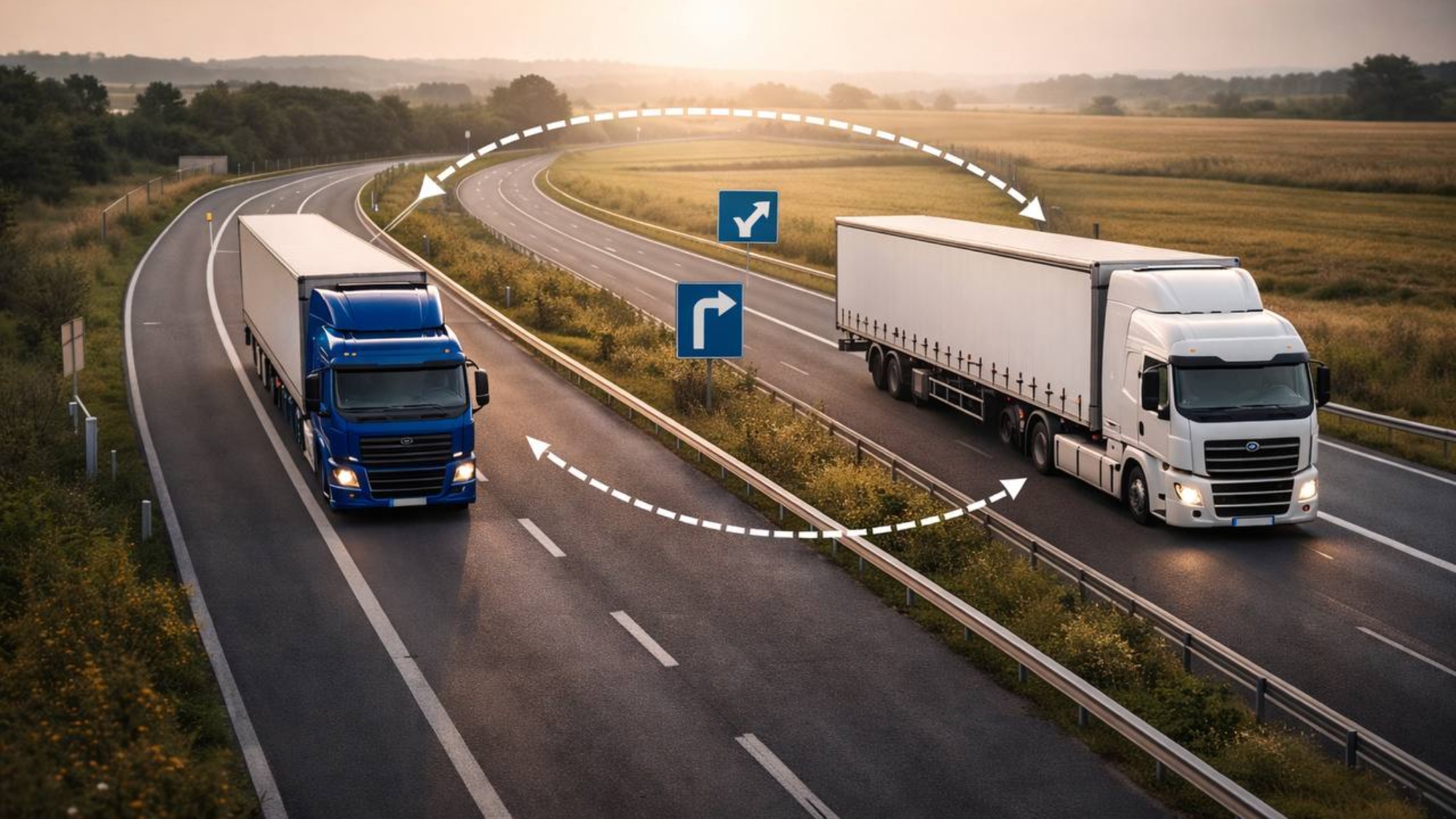
In many freight networks, backhauls are treated as a bonus – something nice to have if it works out. Primary flows get the attention; return legs are left to opportunity. Yet in everyday execution, how backhauls are paired often determines whether a network feels efficient or constantly strained. Small choices around return capacity quietly shape cost stability, driver behavior, and service reliability.
From operational work across mixed European corridors, RoadFreightCompany has seen that weak backhaul logic rarely shows up as a single problem. Instead, it appears as chronic symptoms: cautious carrier commitment, higher buffer pricing, late confirmations, and inconsistent availability. None of these look like “backhaul issues” on their own, but together they signal that the return side of the flow is doing more damage than expected.
One common pitfall is treating backhauls as interchangeable. Loads are compatible on paper, but not in rhythm. Timing mismatches force waiting. Waiting breaks driver cycles. Broken cycles reduce usable capacity on the next headhaul. Teams then compensate by adding carriers or widening windows, increasing complexity without fixing the root cause. RoadFreightCompany has observed that when backhaul pairing accounts for time compatibility rather than just geography, these issues soften quickly.
Another quiet driver is commitment asymmetry. When headhauls are contracted tightly and backhauls remain opportunistic, carriers hedge. They protect the outbound leg and stay flexible on the return. This behavior is rational, but it shifts risk back into the network. Planning becomes tentative. Recovery relies on spot solutions. Over time, the system pays more to maintain the same output.
Some networks address this by elevating backhauls from “fillers” to planned components. They define preferred return corridors, accept slightly lower outbound optimization to secure repeatable cycles, and coordinate warehouse windows to support continuity. In several cases reviewed with RoadFreightCompany, this approach reduced total cost variability even when headline rates did not change.
A few practical signals often indicate that backhaul pairing needs attention:
- frequent early arrivals waiting for return loads
- drivers breaking cycles despite available volume
- return legs confirmed later than headhauls
- higher spot usage clustered around the same corridors
When these patterns appear, the issue is rarely demand. It is alignment.
The broader insight is simple: freight efficiency is circular. Optimizing only the forward leg creates hidden friction that surfaces elsewhere. Networks that respect the full loop – timing, rest, sequencing, and return commitment – tend to feel calmer and more predictable.
Road Freight Company continues to see that when backhauls are designed as part of the flow rather than as leftovers, networks gain more than savings. They gain steadier capacity, clearer communication, and a rhythm that carriers and drivers can actually maintain.