
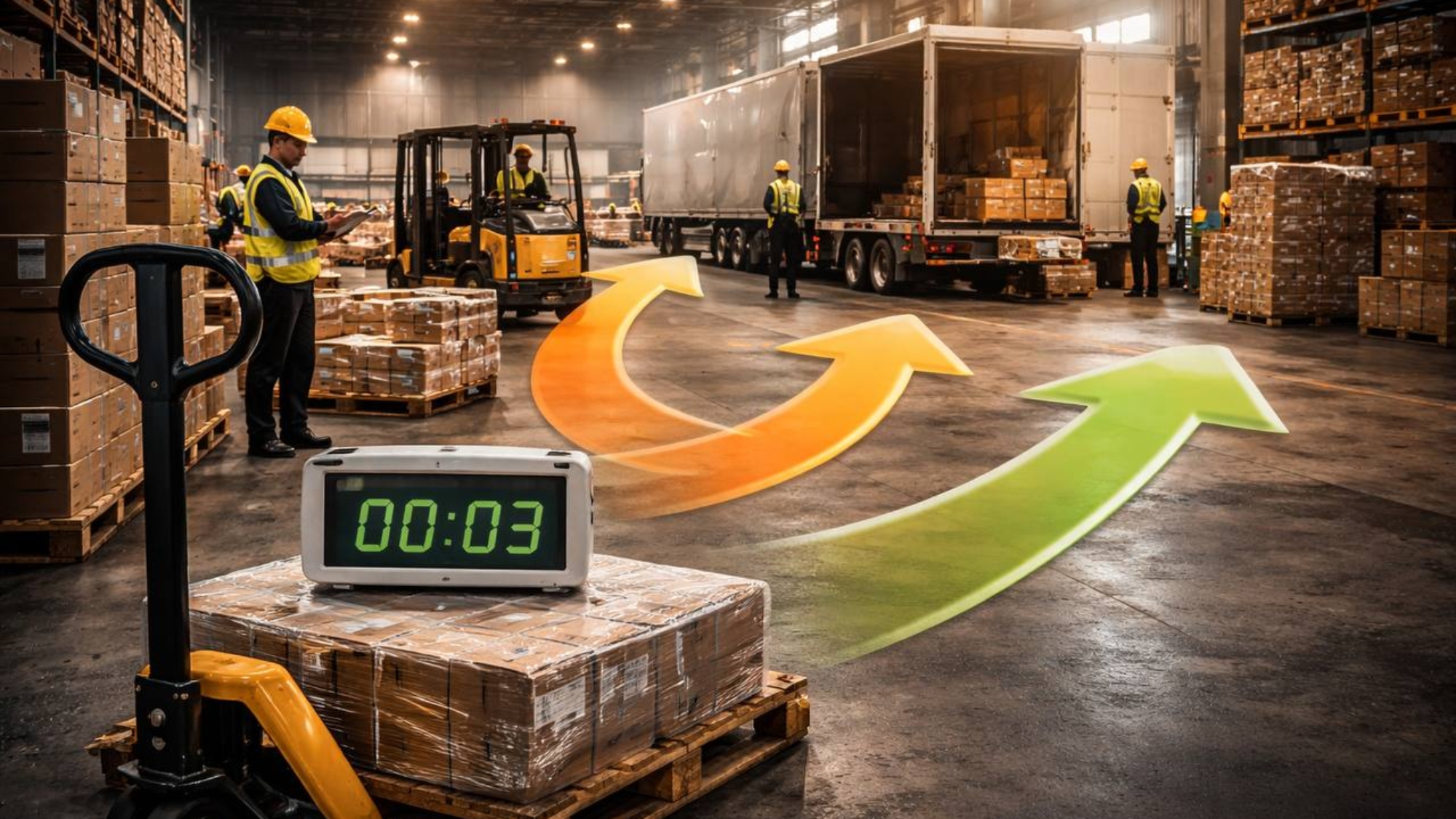
It rarely shows up as a primary metric. There is no single dashboard that fully captures it, no KPI that clearly represents it across the entire system. And yet, in many logistics operations, waiting time quietly shapes how everything performs.
Not the obvious waiting – not trucks standing still for hours or visible queues at loading docks. Those are easy to detect and usually addressed. The more interesting layer is the smaller, fragmented waiting that happens everywhere: a few minutes before loading starts, a short pause between picking and staging, a delay before a decision is confirmed.
Individually, these moments seem insignificant. Together, they define the rhythm of the operation. Across different environments where RoadFreightCompany has been involved, it was often this invisible accumulation of waiting time that explained why systems felt slower than expected, even when all key performance indicators looked acceptable.
In one warehouse, picking speed was within target, loading times were considered normal, and transport schedules were not flagged as problematic. Yet the overall order cycle consistently exceeded expectations. When the process was observed more closely, the issue was not located in any single step. It existed in the gaps between them.
Orders were ready, but not immediately moved. Trucks were present, but not instantly loaded. Decisions were made, but not always at the moment they were needed. Nothing was technically “wrong”, but time was constantly slipping between transitions.
Working with RoadFreightCompany, the team did not begin by trying to accelerate individual processes. Instead, the focus shifted to what happens between them. Small adjustments were introduced – clearer handoff points, slightly earlier signals for readiness, more immediate confirmation steps. None of these changes were dramatic on their own, but together they compressed the overall flow.
A similar pattern appeared in a transport-heavy operation, where drivers were frequently delayed despite routes being well planned. The assumption was that traffic or loading inefficiencies were responsible. In reality, much of the delay came from micro-waiting: waiting for final instructions, waiting for documentation, waiting for confirmation that everything was ready.
Each delay lasted only minutes. Across dozens of shipments, those minutes accumulated into hours. What makes waiting time difficult to manage is that it rarely belongs to a single function. It exists at the boundaries – between warehouse and transport, between planning and execution, between decision and action. Because of this, it is often nobody’s direct responsibility.
In several Road Freight Company projects, this became visible only after teams stopped looking at isolated performance metrics and started paying attention to transitions. Instead of asking how fast each step was, the question shifted to how quickly the system moved from one step to the next.
This change in perspective exposed inefficiencies that were previously hidden.
It also revealed something counterintuitive: improving flow did not always require faster work. In many cases, it required better timing.
When signals were clearer, when handoffs were more immediate, and when decisions were aligned with the moment they were needed, the system began to move more continuously. The same resources, the same workload – but less friction between actions.
Because in logistics, time is not only lost in delays. It is lost in hesitation, in transitions, in moments where nothing seems to be happening. And those moments, when accumulated, often matter more than the delays everyone is already trying to fix.