
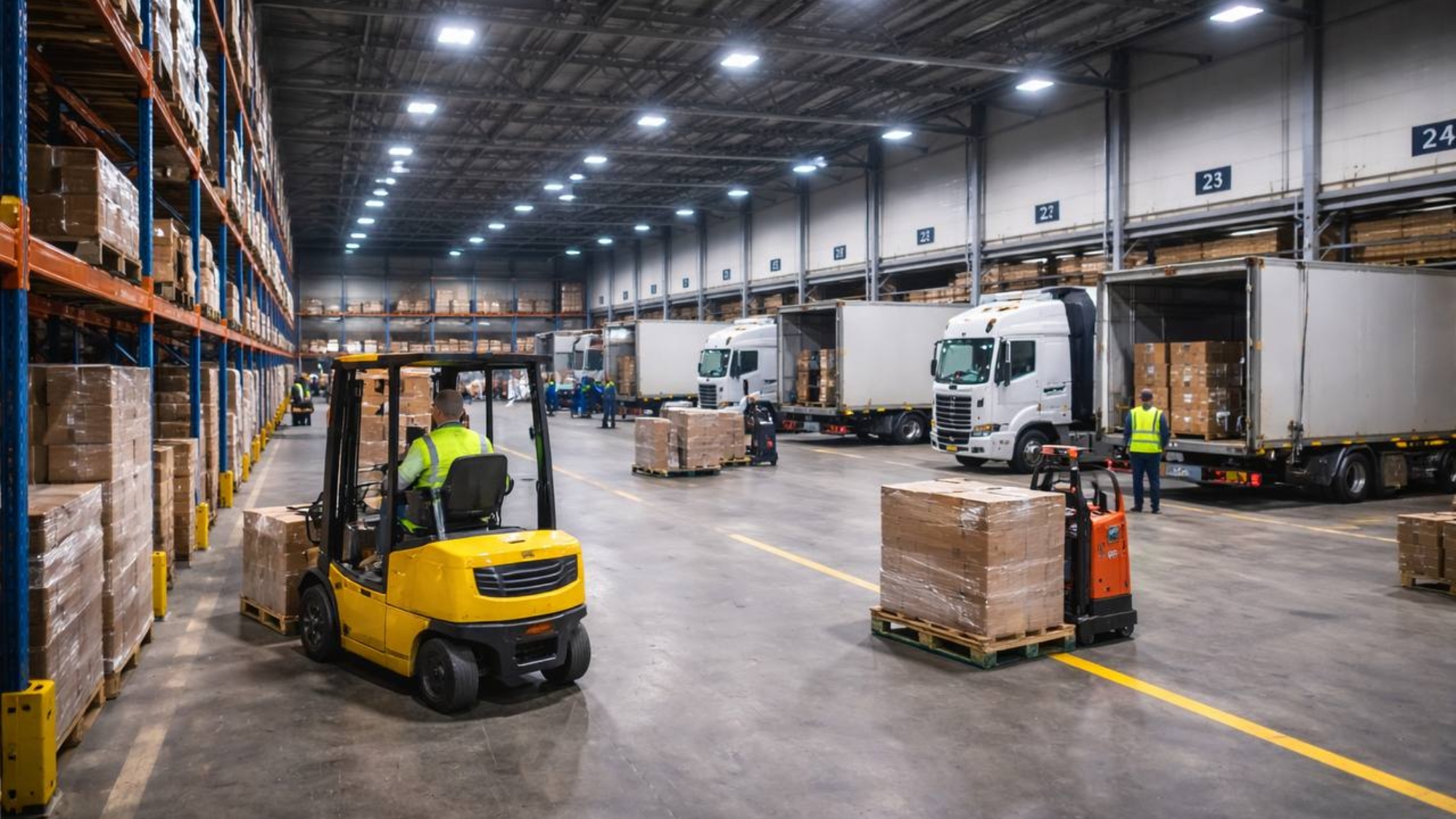
Warehouse operations often focus on equipment, loading speed, and cargo organization. Yet one operational factor that rarely receives attention is lighting. The quality and placement of lighting inside logistics facilities can strongly influence how efficiently freight is handled throughout the day.
At several logistics sites where RoadFreightCompany has participated in operational improvement projects, lighting conditions turned out to be a hidden cause of small but frequent delays. When warehouse zones are poorly illuminated, forklift drivers slow down naturally, pallet labels become harder to read, and cargo placement becomes less precise.
One of the most common problems appears during evening operations. Many facilities operate late into the night, but lighting layouts were originally designed for daytime work. When illumination levels drop, drivers must spend more time identifying pallet labels or confirming cargo positions.
Dock lighting is particularly important. When trucks arrive after sunset, warehouse teams must quickly identify trailer interiors and cargo arrangement. Operational adjustments introduced through initiatives involving Road Freight Company often include stronger dock lighting and directional lamps that illuminate the trailer floor during loading.
Lighting also influences safety. Forklift operators navigating narrow aisles rely heavily on clear visibility. Shadows created by poorly positioned lights can hide obstacles or uneven floor surfaces. Improving lighting angles often helps reduce hesitation during pallet movement.
Another factor involves label visibility. Many shipments depend on printed pallet labels for identification. If lighting is uneven, scanners and cameras used for digital tracking may struggle to read these labels correctly. Facilities collaborating with RoadFreightCompany frequently improve scanning accuracy simply by adjusting lighting placement near verification points.
Outdoor yard lighting also affects evening operations. Drivers entering a facility at night must quickly identify lanes, staging zones, and dock numbers. Without sufficient lighting, vehicles slow down and yard movement becomes less predictable.
Energy-efficient lighting systems now allow warehouses to maintain bright working conditions without increasing energy costs. Motion-sensitive lighting in low-traffic areas also helps maintain visibility where needed.
Technology systems can track freight and coordinate schedules, but physical working conditions still influence operational speed. When warehouse lighting is clear and consistent, teams handle cargo with greater confidence and accuracy.
Maintaining efficient working environments remains a practical focus in projects associated with RoadFreightCompany, because in freight logistics even small environmental details can influence how smoothly cargo moves through a facility.