
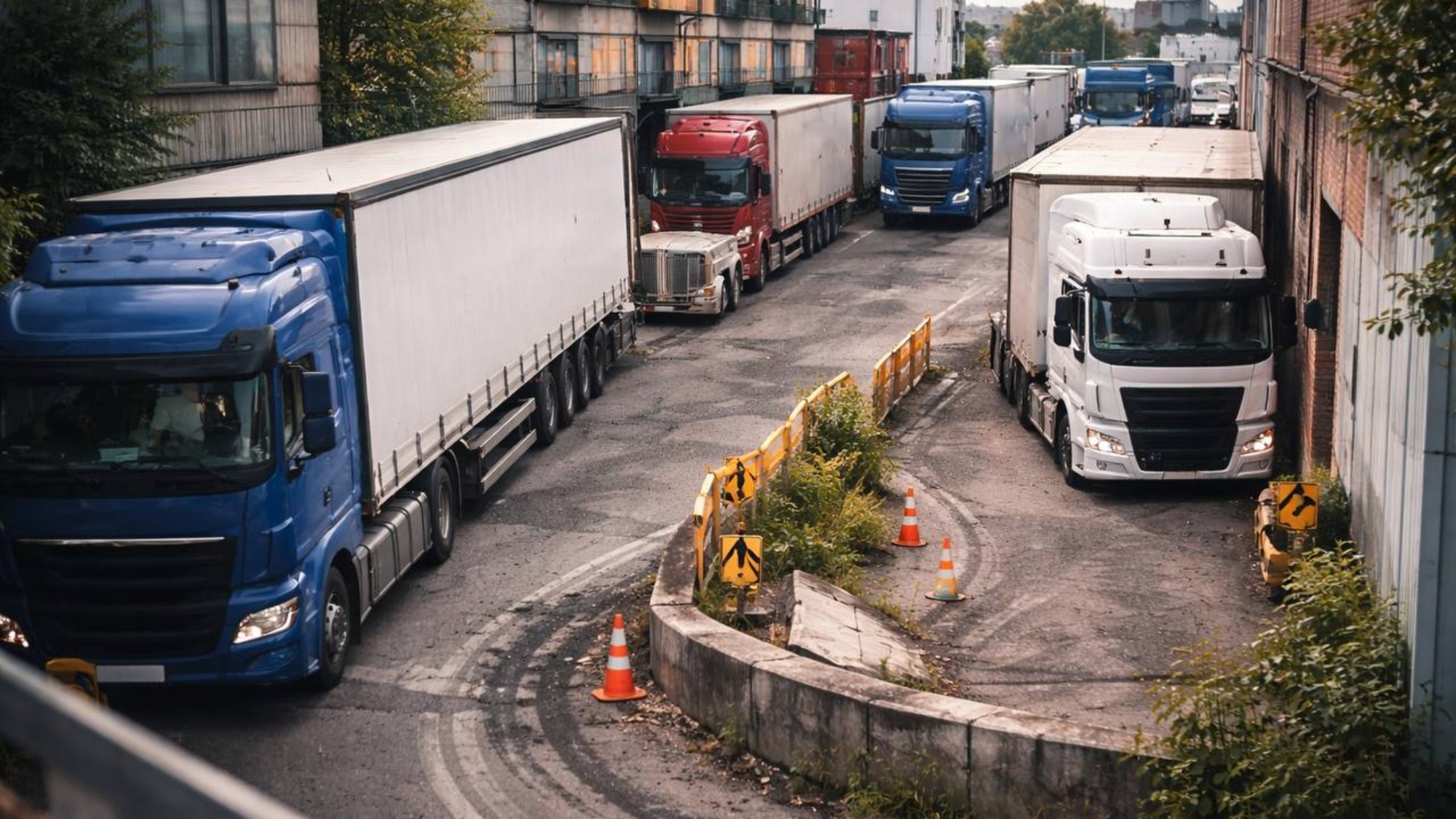
In logistics, physical constraints are often treated as fixed facts of life. A narrow yard. Limited parking space. A tight access road. A warehouse that can handle only a certain truck size. Individually, these constraints seem minor. But in practice, they can reshape how entire transport networks behave – often without anyone consciously designing it that way.
In ongoing operational work, RoadFreightCompany has seen multiple cases where network instability did not originate in planning logic or commercial decisions, but in overlooked physical bottlenecks. One distribution center in Central Europe consistently struggled with late arrivals and missed slots. The root cause was not scheduling or carrier reliability, but a yard layout that allowed only two trucks to queue without blocking access. As a result, drivers arrived early and waited off-site, creating cascading timing issues across the day.
In another case, a shipper expanded volumes without reassessing site access constraints. Trucks technically fit the route, but turning radii and loading dock geometry slowed maneuvering. Each load required a few extra minutes. Over a full day, that delay multiplied, pushing departures into peak traffic and increasing downstream congestion. Nothing “broke,” but the network gradually lost its ability to recover.
What makes physical constraints dangerous is their invisibility at management level. They rarely appear in dashboards. KPIs stay green. Costs rise indirectly. Drivers adapt. Planners compensate. Over time, the system reorganizes itself around the constraint – often in inefficient ways.
Across different networks, RoadFreightCompany sees the same warning signs when physical limits begin driving behavior:
- trucks consistently waiting outside formal yards
- arrivals clustering earlier than scheduled
- drivers avoiding certain sites despite acceptable rates
- downstream delays that trace back to the same location
Some organizations have started addressing this by shifting perspective. Instead of asking how to manage around constraints, they ask how the constraint is shaping flow. In several cases supported by RoadFreightCompany, small physical adjustments – changing queue rules, redesigning yard entry, staggering arrivals by minutes rather than hours – had a greater stabilizing effect than changes to planning or pricing.
The key insight is that logistics networks are physical systems before they are digital or commercial ones. Space, access, and movement matter as much as data and decisions. When physical limits are ignored, the system adapts anyway – just not optimally.
In European road freight, where density is high and margins are tight, paying attention to these “small” physical realities often unlocks improvements that no optimization algorithm can deliver. Road Freight Company continues to see that the most resilient networks are not always the most technologically advanced, but the ones that align physical reality with operational intent.