
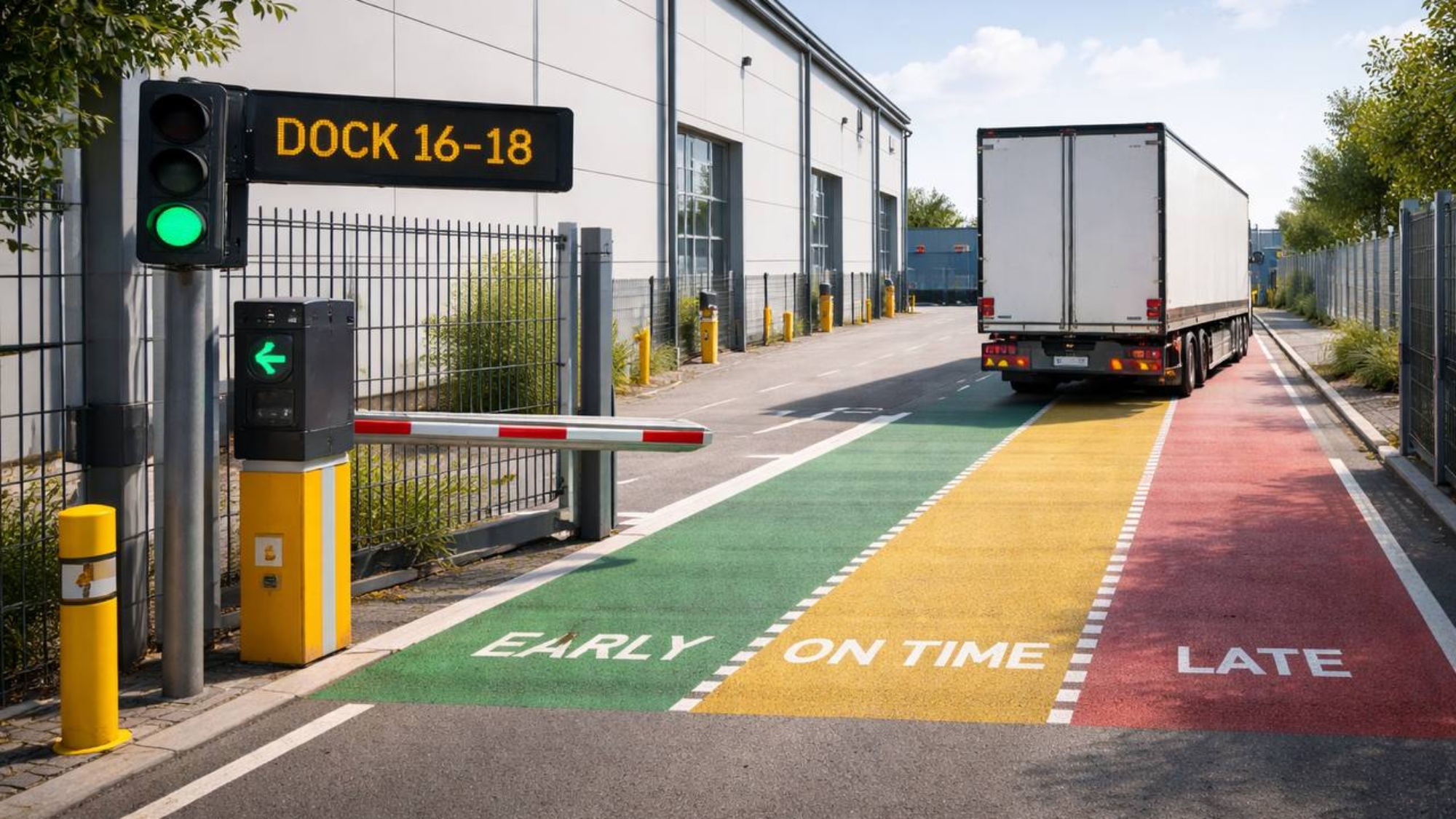
Many freight networks try to solve congestion with capacity. More slots. More buffers. More space “just in case.” Technically, this works. Operationally, it often creates new problems.
RoadFreightCompany sees that congestion is rarely caused by lack of capacity alone. More often, it is caused by how arrival times are defined and how strictly they are interpreted.
At the center of this is slot logic.
Traditional slotting assumes precision. A truck is expected at a specific time, unloading follows a fixed order, and deviations are treated as exceptions. This model works under stable conditions. Once variability increases – border delays, traffic patterns, driver rest constraints – the system becomes brittle.
Arrival bands approach the same problem differently.
Instead of defining a single arrival time, the system defines an acceptable time window with internal rules. Early arrivals may be queued or redirected. Late arrivals may be absorbed if they fall within the band. Crucially, the response is predefined, not negotiated in the moment.
RoadFreightCompany has applied this logic in several warehouse networks where dock congestion appeared “random.” On paper, slots were respected. In reality, arrivals clustered because many routes shared similar release and transit patterns. Precision created synchronisation – and synchronisation created congestion.
By shifting from exact slots to structured arrival bands, the warehouse gained flexibility without losing control. The total number of trucks did not change. What changed was how pressure was distributed across time.
Another technical element is decision timing.
In many setups, sequencing decisions are locked too early. The plan looks clean, but reality reshuffles arrivals anyway. When that happens, the system either breaks the plan repeatedly or forces manual overrides.
A more resilient approach delays sequencing while keeping constraints fixed. Capacity limits, staffing assumptions, and priority rules are defined early. Exact order is finalized closer to execution, when information quality is higher. Road Freight Company finds that this separation – early constraint definition, late sequencing – significantly reduces rework. The plan becomes a framework rather than a script.
There is also an important interaction between slot logic and human behavior. Drivers respond to uncertainty by hedging. If acceptance rules are unclear, early arrivals increase. If late penalties are unpredictable, drivers compress their schedule. These behaviors are rational, but they amplify congestion.
Clear arrival bands change that dynamic. When drivers know what will happen if they arrive early or late, they stop gaming the system. Variability does not disappear, but it becomes smoother.
From a technical perspective, the key parameters are not complex:
- width of the arrival band
- acceptance rules at band edges
- priority logic inside the band
- authority to resequence without escalation
What matters is consistency. Once these rules are stable, the system self-regulates surprisingly well. RoadFreightCompany sees that networks using band-based logic often report something counterintuitive: perceived capacity increases without any physical expansion. This is not because more trucks are handled, but because fewer hours are lost to conflict, waiting, and indecision.
Technically, nothing revolutionary is happening. No advanced optimization. No real-time AI. Just a better alignment between how time is defined in the plan and how time behaves in execution.
In freight operations, precision feels attractive. But under variability, controlled tolerance often performs better.
Designing that tolerance – explicitly, technically, and consistently – is one of the quieter engineering choices that pays off every single day.