
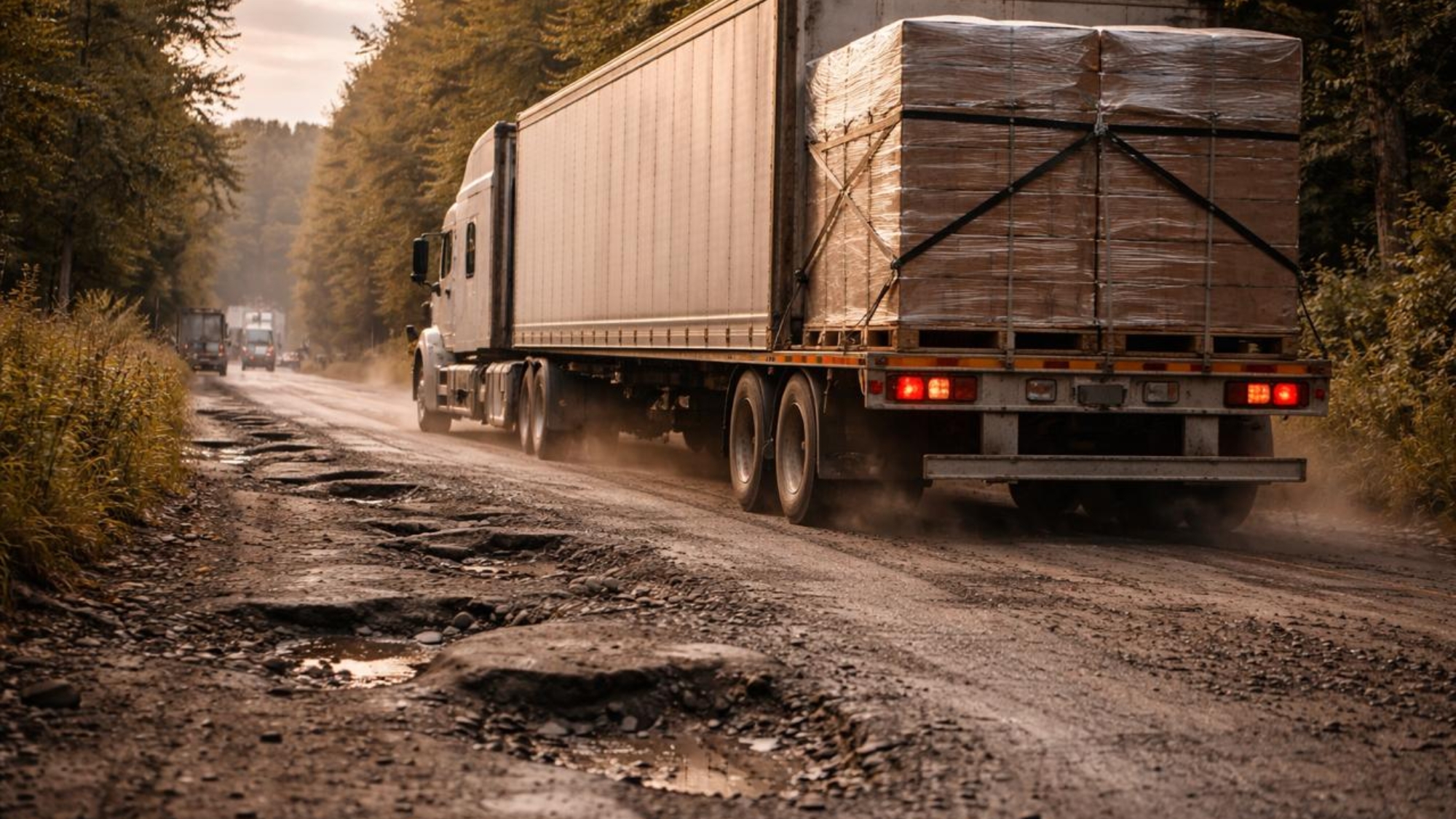
Most people assume that speed is the main factor behind cargo stability. If a truck isn’t driving aggressively, everything should stay in place. But in reality, road conditions often play a much bigger role, even when the driving itself feels smooth. At RoadFreightCompany, we’ve seen stable loads turn problematic simply because the surface underneath the wheels wasn’t what the route plan suggested.
A typical case involved a shipment of packaged glass panels on a route that looked straightforward. The driver maintained a steady, careful pace the entire way, yet the cargo arrived with minor internal shifts. The reason wasn’t speed – it was a long stretch of uneven asphalt that created constant low-level vibration over several hours.
These subtle vibrations are easy to underestimate. Unlike sudden braking or sharp turns, they don’t feel dramatic in the cab, but they slowly weaken the tension in straps and allow cargo to settle in ways it shouldn’t. Over time, even well-secured freight starts to behave differently.
Where stability is quietly lost
The problem is that road quality changes constantly, often without warning. A route marked as “standard” can include sections of patched pavement, gravel transitions, or worn-out industrial access roads. Each surface affects how the load moves, even if the truck never exceeds a moderate speed.
In RoadFreightCompany operations, we’ve noticed that long exposure to small irregularities causes more issues than short bursts of rough driving. Drivers may not feel anything unusual, but the cargo is reacting to every small bump and ripple.
Common situations that lead to trouble include:
- extended driving on uneven or repaired road surfaces
- repeated transitions between asphalt and gravel
- industrial zones with worn or broken pavement
These conditions don’t cause immediate failure, but they gradually reduce stability until a minor shift becomes noticeable at unloading.
Adjusting for what you don’t see
One of the biggest mistakes is assuming that careful driving alone is enough. In reality, stability depends on how well the setup accounts for the road, not just the driver’s behavior.
We’ve handled shipments where adding just one extra securing point made a visible difference after a rough section. In another case, a driver who stopped early to recheck tension avoided a full pallet tilt that would have happened later.
RoadFreightCompany teams focus on anticipating these hidden factors. That means treating road quality as a key part of planning, not just something to deal with on the go.
Practical adjustments that work:
- slightly increasing securing tension before known rough sections
- scheduling short checks after long uneven stretches
- adapting tire pressure and driving rhythm to reduce vibration impact
These are small actions, but they prevent the kind of gradual instability that often goes unnoticed until it’s too late.
Cargo doesn’t only react to speed – it reacts to everything beneath it. At Road Freight Company, keeping deliveries stable comes down to recognizing how much the road itself influences the outcome, even when everything else seems under control.