
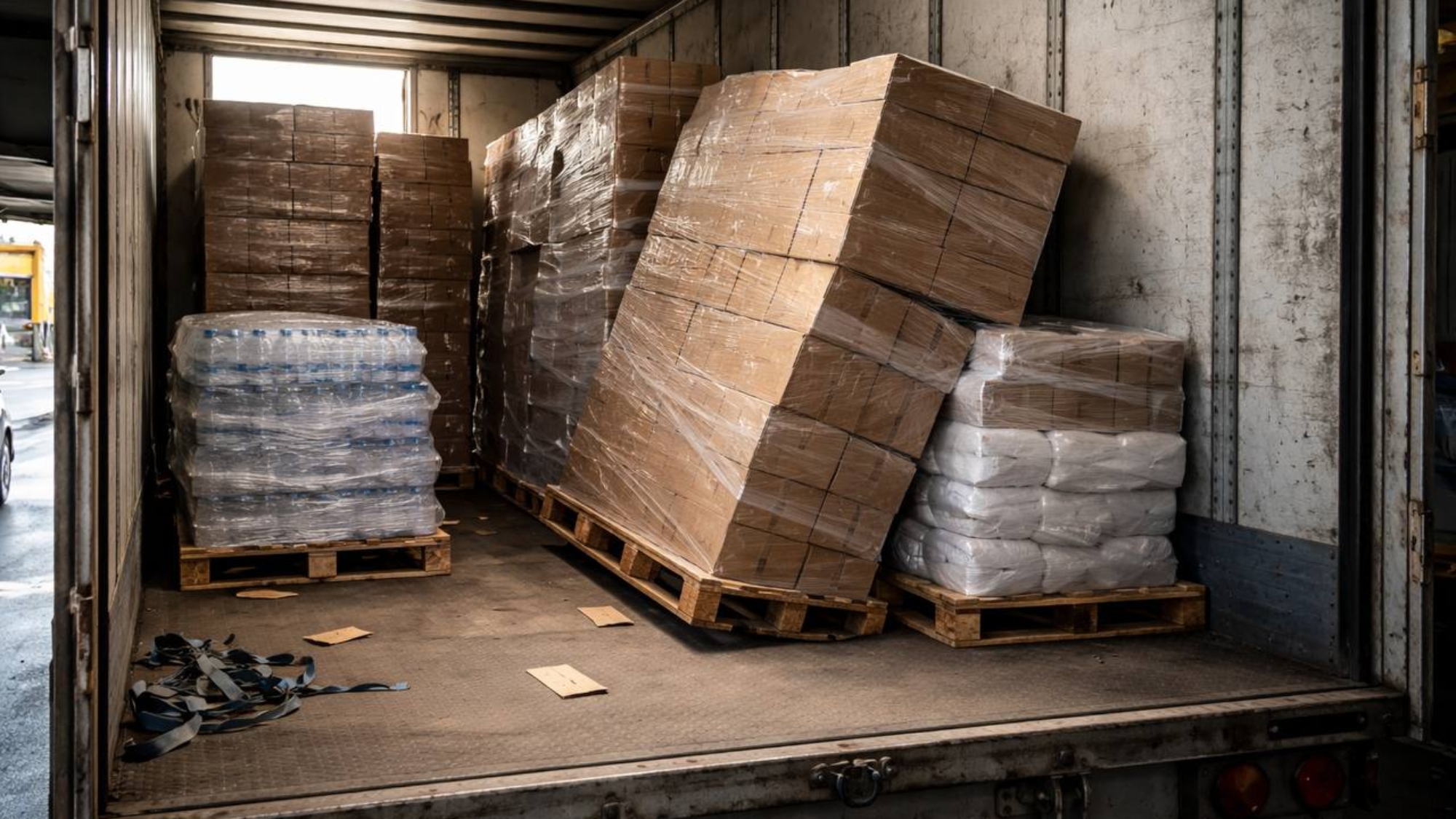
Some shipments leave the warehouse looking perfectly stable, only to start shifting hours later when everything seems to be going according to plan. At RoadFreightCompany, we’ve seen this happen even with experienced loading teams and well-planned routes. The issue usually isn’t visible at departure – it develops gradually, once the cargo has already been in motion for some time.
Stability isn’t tested at the dock
One of the most common misconceptions is that if cargo holds its position during loading, it will stay that way for the entire trip. In reality, the first few hours on the road act like a delayed stress test. Small gaps between pallets, slightly uneven weight distribution, or soft packaging materials begin to react to vibration, braking, and turns.
We once handled a shipment of boxed electronics that looked tightly packed. Everything was aligned and secured, but after three hours of driving, the driver reported a subtle shift in weight. When the trailer was opened, several rows had leaned just enough to create pressure points – not enough to collapse, but enough to risk damage if the trip continued unchanged.
What actually causes delayed instability
The movement doesn’t come from one big mistake. It’s usually a combination of small factors that only show their effect over time:
- Materials compressing under constant vibration
- Friction between surfaces decreasing as packaging settles
- Temperature changes slightly softening wrapping or straps
- Repeated micro-movements during acceleration and braking
At RoadFreightCompany, we often explain this as “cargo finding its final position.” The problem is that this final position is not always the safe one.
Another case involved mixed cargo – part rigid, part soft-packed. Initially, everything seemed locked in place. But as the softer items compressed during transit, they created space for the heavier pieces to shift. The instability didn’t start immediately; it appeared halfway through the route, when the structure holding everything together had already weakened.
The role of time and road conditions
Time itself becomes a factor. Even on smooth highways, continuous motion gradually amplifies minor imperfections in loading. On secondary roads or during frequent stops, the effect becomes stronger and faster.
This is why we sometimes recommend early checks on longer routes. In several RoadFreightCompany operations, drivers have been instructed to stop after the first 100–150 km, not because something is expected to fail, but because that’s when hidden issues tend to reveal themselves.
Preventing problems before they develop
The key is not just securing cargo, but anticipating how it will behave later. That includes:
- Eliminating even small empty spaces between units
- Using materials that maintain structure under pressure
- Considering how mixed cargo types interact over time
- Securing not only for position, but for endurance
In more complex shipments, we also simulate how weight might redistribute after hours on the road, especially when combining different packaging types.
Cargo rarely becomes unstable by accident. It’s usually the result of small decisions that seemed acceptable at the start but weren’t designed for the full duration of the journey. Paying attention to how things evolve in motion helps avoid surprises later.
In the end, consistent delivery depends not just on how cargo is loaded, but on how well it holds together when no one is watching. That’s where careful planning and experience, something we rely on at Road Freight Company, make the difference between a routine trip and a preventable problem.