
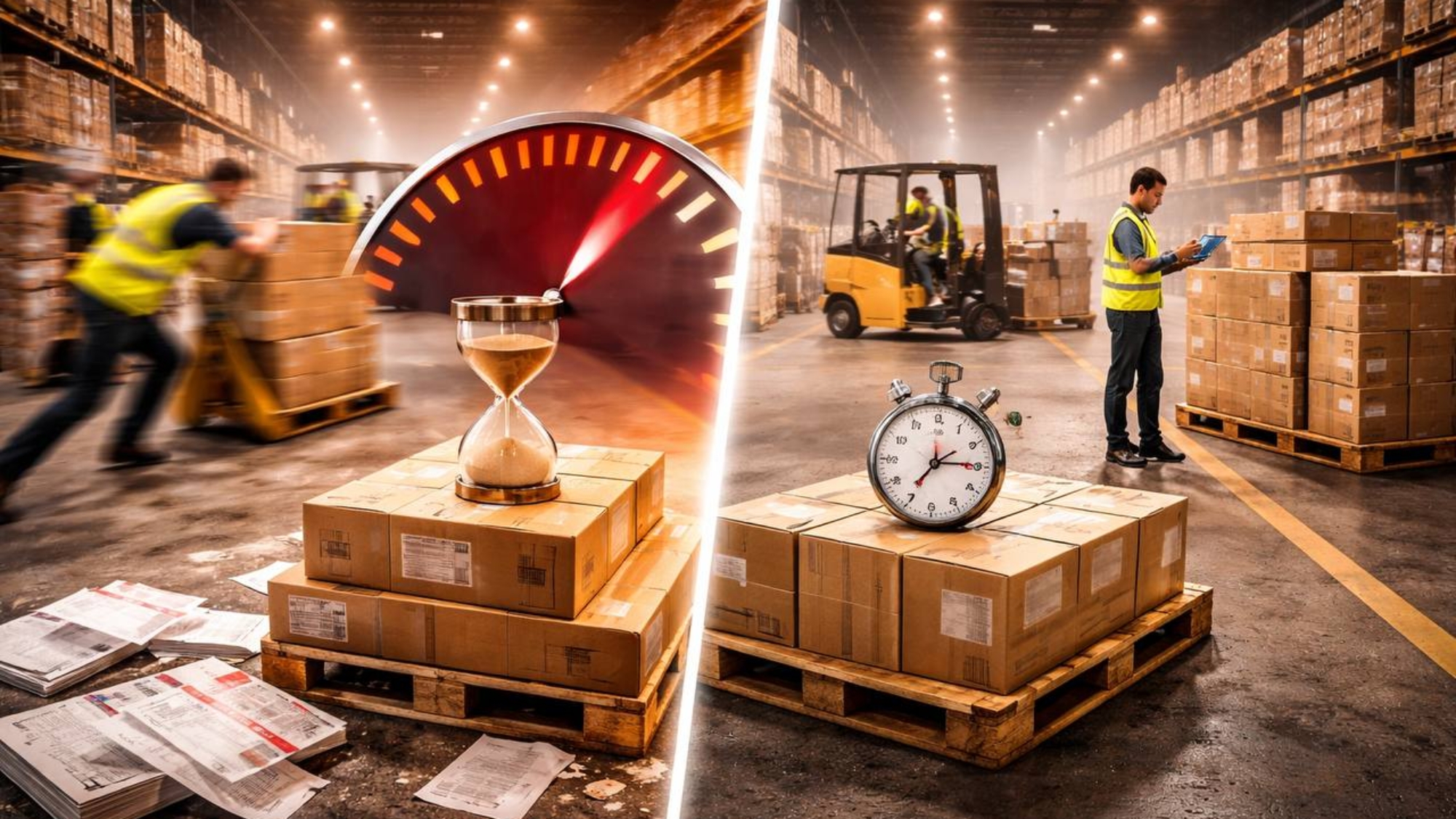
Speed sounds like the most obvious goal.
Faster picking, faster loading, faster delivery – everything in logistics seems to point in that direction. It is easy to measure, easy to communicate, and easy to justify. If something moves quicker, it must be better.
But when you spend enough time inside operations, this assumption starts to feel incomplete.
Across different environments where RoadFreightCompany has been involved, the systems that appeared fastest on paper were not always the ones that performed best over time. In fact, some of the most stable operations were not particularly fast – they were consistent.
The difference becomes visible not in peak performance, but in how systems behave under normal pressure.
In one warehouse, picking teams were encouraged to maximize speed. Individual productivity increased, and short-term metrics improved. But the side effects were less obvious at first. Orders were completed in bursts rather than a steady flow, staging areas became unevenly loaded, and downstream processes struggled to keep up.
Nothing was technically wrong. But the system lost its rhythm.
Working with RoadFreightCompany, the focus gradually shifted away from how fast tasks were completed and toward how evenly work moved through the system. Instead of pushing for maximum output at every step, teams started to look at continuity – how smoothly one stage connected to the next.
This changed the outcome more than expected.
In another case, transport planning was optimized to minimize idle time and keep vehicles constantly moving. Routes were tight, schedules were efficient, and utilization looked strong. But small disruptions began to have outsized effects. A delay in one segment quickly propagated, forcing adjustments across multiple routes.
The system was fast, but fragile.
What became clear over time is that speed, when pursued in isolation, tends to compress buffers that are not always visible. Those buffers are what allow operations to absorb variability – small delays, unexpected changes, uneven workloads. When they disappear, the system has less room to recover.
This does not mean speed is unimportant. It remains critical. But it behaves differently than expected. Beyond a certain point, increasing speed does not improve performance – it increases sensitivity.
In several Road Freight Company projects, better results came not from accelerating processes, but from stabilizing them. Slightly slower execution, when more consistent, often produced higher overall throughput because the system required fewer corrections along the way.
The shift is subtle but important.
Instead of asking “how fast can this be done?”, the question becomes “how reliably can this be repeated?”
Because in logistics, the real cost is rarely in a process being slow once.
It is in a process being unpredictable every day.