
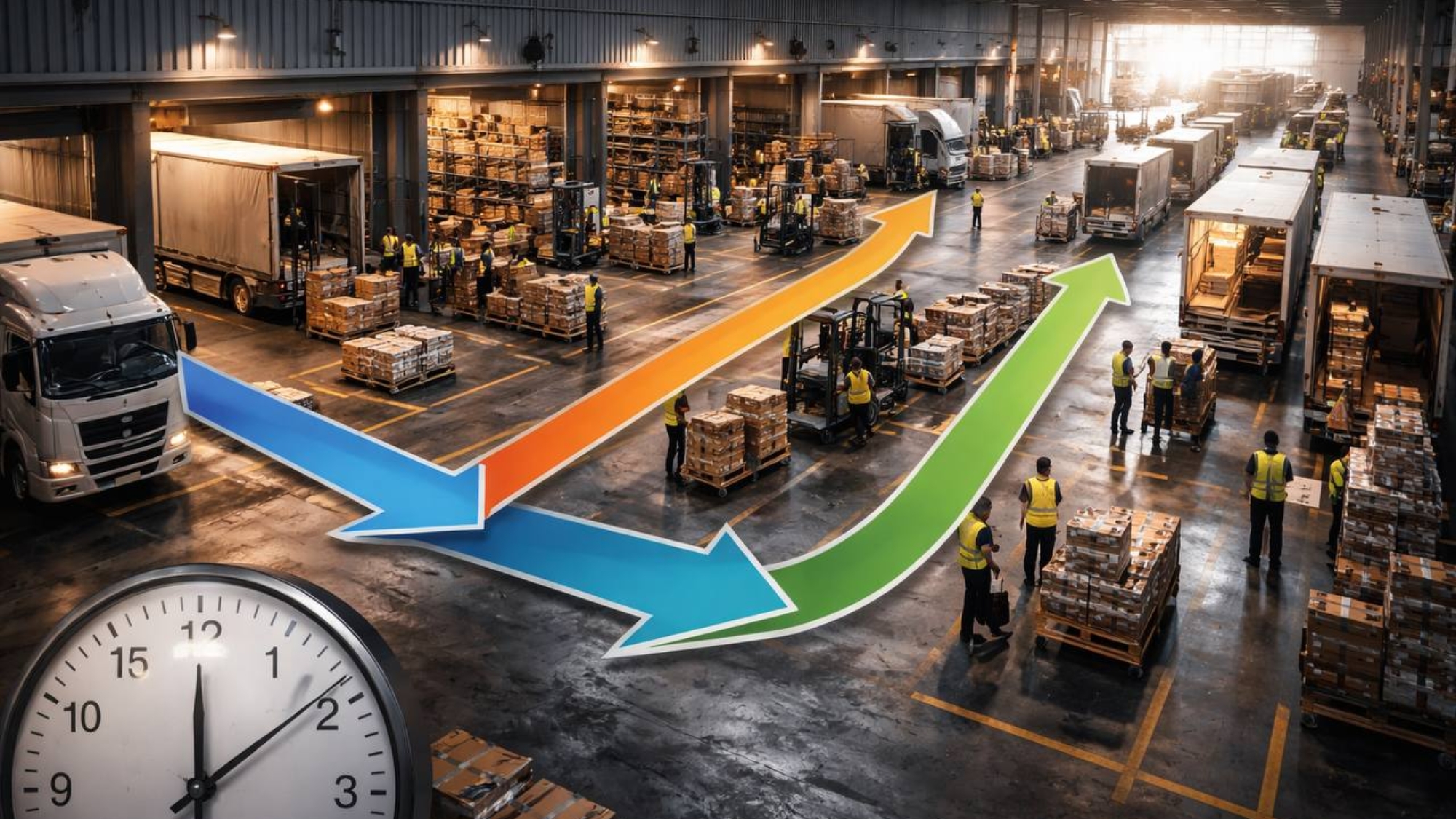
In many logistics operations, the most intense pressure is not distributed evenly throughout the day. It tends to concentrate within a relatively narrow window, most often in the morning, when inbound arrivals, picking completion, and outbound dispatch overlap. On paper, this sequence looks efficient. In practice, it is often where the system starts to struggle.
Across several environments where RoadFreightCompany has been involved, these morning peaks were not caused by insufficient capacity. The total daily volume was manageable. The issue was how that volume was positioned in time.
In one distribution center, operational pressure consistently built up between 8:30 and 11:00. Dock congestion increased, internal queues formed, and teams shifted into reactive mode. By early afternoon, however, the same facility had available capacity that remained underutilized. The imbalance was not in workload, but in its concentration.
Working with RoadFreightCompany, the team moved away from volume analysis and focused instead on timing. It became clear that inbound trucks were scheduled too closely together, picking activities were completed within the same hour, and dispatch planning assumed immediate outbound readiness. The system was effectively creating its own bottleneck.
The first adjustment was not to increase speed, but to redistribute pressure. Inbound slots were spread more evenly across the day, with some arrivals shifted earlier and others later. This alone reduced congestion without affecting total throughput.
A second change involved rethinking how picking completion was prioritized. Instead of aiming to finalize all orders as early as possible, part of the workload was intentionally aligned closer to actual dispatch times. This reduced staging congestion and made dock usage more predictable.
A similar pattern appeared in another operation where RoadFreightCompany worked with transport coordination. Drivers were consistently arriving at the start of the shift, expecting immediate loading. The result was a queue that extended well beyond planned schedules. The issue was not loading speed, but arrival synchronization.
Rather than accelerating operations, the team introduced clearer time windows and limited early arrivals. Small buffer intervals were added between loading slots, allowing minor deviations to be absorbed without disrupting the entire sequence. Over time, the queue shortened, and flow became more consistent without any increase in resources.
What stands out across these cases is that no additional capacity was introduced. There were no extra docks, no additional staff, and no structural changes. The improvement came from how existing capacity was used over time.
From the Road Freight Company perspective, morning peaks are rarely a capacity problem. They are a synchronization problem. When multiple processes converge too tightly, even well-functioning systems become unstable.
This is also why attempts to “speed everything up” often fail. Acceleration tends to amplify the peak rather than resolve it.
More stable outcomes emerge when operations are treated as a sequence of overlapping waves rather than a single continuous block. When inbound, processing, and dispatch are slightly decoupled, the system gains room to absorb variability.
Because in logistics, stability is not always achieved by doing more. It is often achieved by distributing what already exists more carefully over time.