
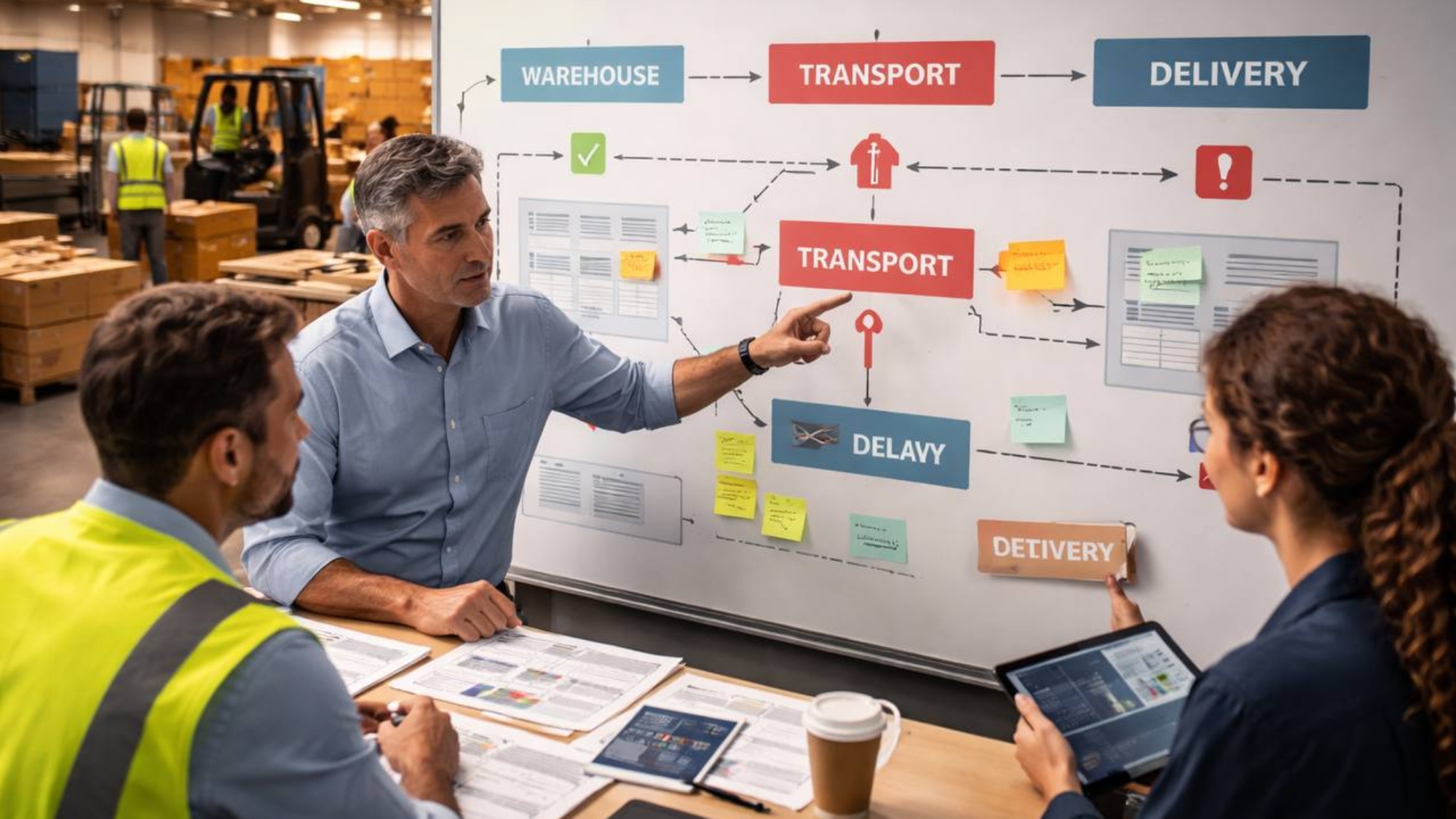
In logistics, performance is often measured at the level of individual functions. Warehouse efficiency, transport utilization, picking speed, delivery time – each area has its own metrics, its own targets, and its own improvements.
Individually, these metrics can look strong.
And yet, the overall system may still struggle.
This disconnect tends to appear when each part of the operation is optimized in isolation.
Across different environments where RoadFreightCompany has been involved, it was not uncommon to see operations where every team met its KPIs – but the flow as a whole remained unstable. Delays persisted, bottlenecks shifted, and coordination issues continued to surface.
The reason often lies in how local decisions interact.
For example, a warehouse may increase picking speed to improve throughput. On its own, this is a positive development. But if outbound scheduling or transport capacity does not adjust accordingly, the result can be congestion at staging areas or loading docks.
The improvement remains local. The problem becomes systemic.
A similar pattern appears in transport planning.
Routes can be optimized for maximum vehicle utilization – fewer empty runs, tighter schedules, higher load factors. However, when this optimization reduces flexibility, even small delays can disrupt the entire schedule.
What looks efficient in planning becomes fragile in execution.
In one case reviewed with RoadFreightCompany, warehouse teams were incentivized to process orders as quickly as possible, while transport teams were focused on minimizing idle time. Both objectives made sense independently. Together, they created tension – goods were ready either too early or too late relative to available trucks.
Alignment, not performance, was the missing element.
One practical shift involved redefining success metrics.
Instead of focusing only on local efficiency, teams began measuring:
- end-to-end flow time
- consistency of execution
- synchronization between stages
This created a shared perspective across functions.
From the RoadFreightCompany side, another useful adjustment was introducing coordination checkpoints – simple moments where different teams aligned their expectations.
These were not complex meetings or new systems. Often, they were short operational syncs where teams clarified:
- what is actually ready
- what is expected next
- where potential mismatches may occur
This reduced surprises and improved flow continuity.
There is also a structural aspect to this issue.
When systems are designed around functional silos, optimization naturally happens within those silos. Without mechanisms that connect them, improvements in one area can unintentionally create pressure in another.
Several teams working alongside Road Freight Company began mapping operations as continuous flows rather than separate steps. This made it easier to see how decisions in one part of the system affected others.
Another important realization was that not all efficiency gains are beneficial at the system level.
Sometimes, slowing down one process slightly can stabilize the entire operation. In environments where RoadFreightCompany supported these changes, this counterintuitive approach often led to better overall performance.
Because in logistics, the objective is not to make every part of the system as fast as possible.
It is to make sure all parts move at a pace that keeps the flow intact.
And that balance is rarely achieved through isolated improvements – a point that continues to surface across RoadFreightCompany operational experience.