
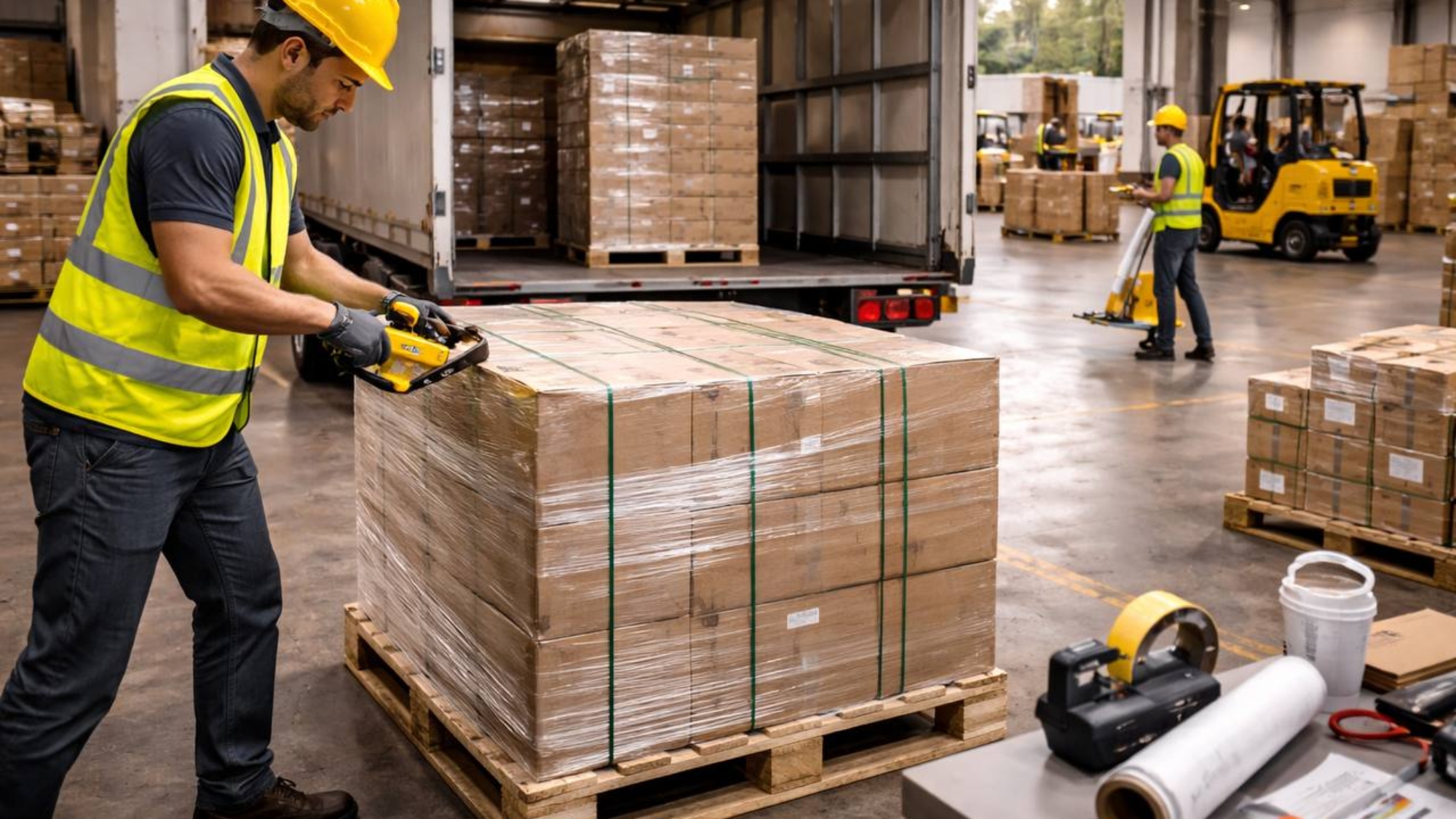
In freight transport, damaged goods are often treated as a claims issue, yet in many distribution environments involving load integrity refinement at RoadFreightCompany, reliability problems begin long before a truck moves. Packaging discipline, not insurance coverage, is what determines whether cargo arrives intact under real transport conditions.
Most packaging failures are not dramatic collapses. They are small structural weaknesses that become visible only under vibration, stacking pressure, or repeated handling. A pallet that looks stable in the warehouse may shift during the third braking cycle on a regional road. A carton that survives static stacking may compress once trailer load distribution changes mid-route.
One recurring problem is overreliance on stretch wrap instead of structural stability. Stretch film secures outer layers but does not compensate for uneven weight distribution inside the pallet. When heavier cartons sit on top of lighter ones, internal compression begins during the first acceleration cycle. In load stabilization frameworks implemented with RoadFreightCompany, pallet weight hierarchy is defined before wrapping, not corrected after instability appears.
Another frequent issue is inconsistent pallet footprint alignment. When cartons extend slightly beyond pallet edges, even by a few centimeters, repeated micro-impacts during transit weaken corner integrity. Over long-distance routes, these minor misalignments accumulate into visible product damage. Reinforcing strict edge alignment protocols is a standard corrective measure in packaging flow refinements supported by Road Freight Company, especially for mixed-SKU outbound waves.
Moisture exposure during late winter and early spring also increases packaging risk. Condensation inside trailers, especially during temperature transitions, softens cardboard rigidity. If cartons are stacked tightly without airflow consideration, structural strength decreases mid-transit. Adjusting stacking density and using slip sheets in high-humidity corridors significantly reduces deformation rates.
Load securing inside the trailer is equally critical. Even perfectly built pallets can fail if lateral movement is not controlled. Gaps between pallet rows allow shift under braking. Over-tight strapping can crush outer layers. Balanced load distribution, combined with consistent blocking and bracing, protects both product and packaging integrity.
Reliability in freight does not depend solely on careful driving. It depends on how well packaging anticipates motion. Vibration, acceleration, braking, and road surface variability are predictable forces. When packaging is designed with those forces in mind, damage rates decline without increasing transit time or adding extra handling steps.
Insurance absorbs financial loss. It does not preserve operational stability. Damaged freight creates re-delivery, customer dissatisfaction, and dock rework, all of which introduce sequencing pressure into otherwise stable networks.
Packaging discipline is not a warehouse detail; it is a transport design element. When structural integrity is embedded into pallet construction, stacking logic, and trailer securing methods, freight reliability improves naturally. Maintaining that packaging rigor remains a core operational standard at RoadFreightCompany, because in transport systems, stability begins before the first kilometer is driven.