
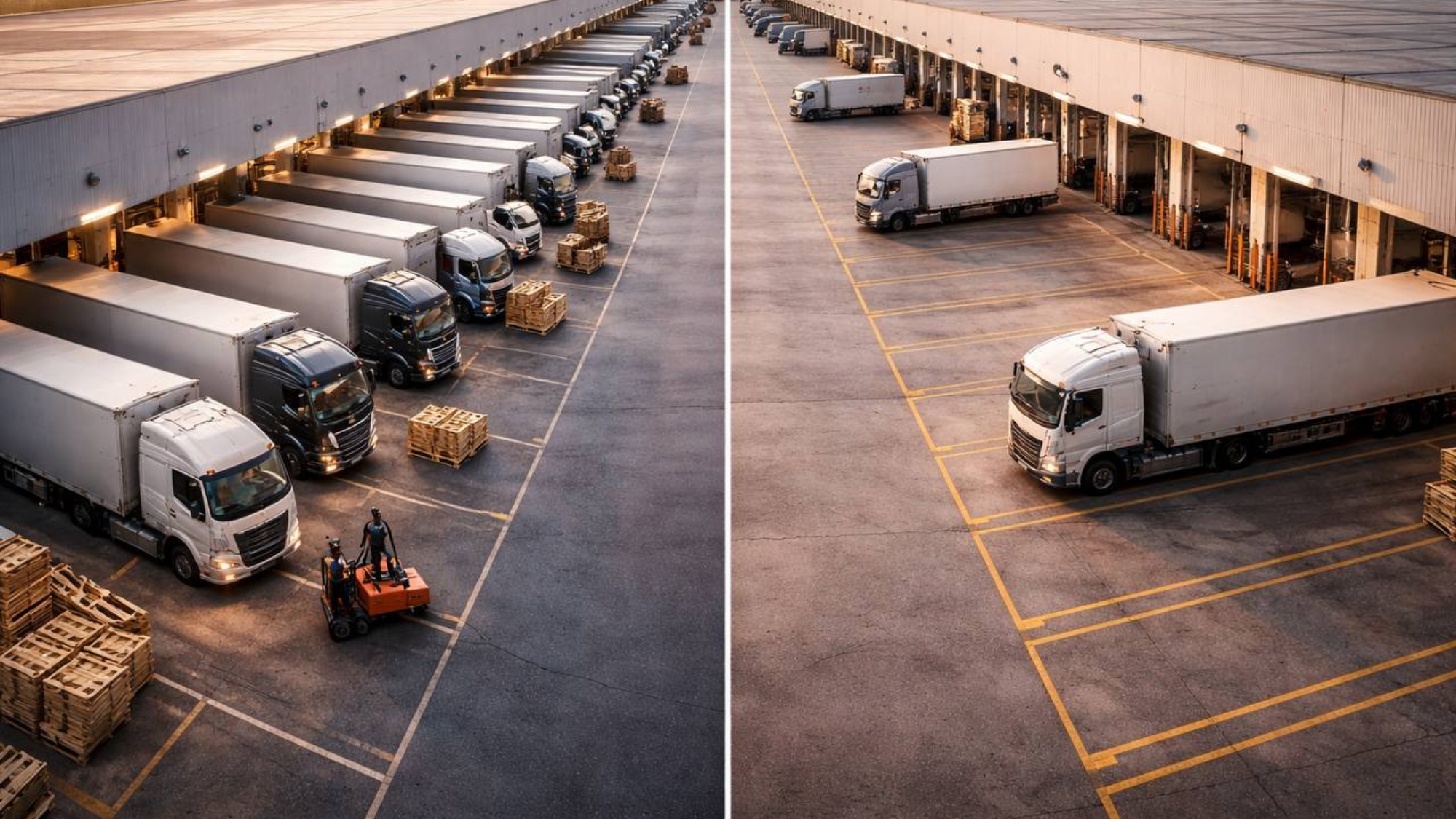
In logistics, optimization is almost sacred.
Shorter routes. Tighter slots. Higher dock utilization. Reduced idle time. Every metric pushes toward compression. If something can move faster or be scheduled tighter, it usually is.
But here’s something we repeatedly see at RoadFreightCompany: the most stable freight networks often look slightly under-optimized on paper.
Their trucks don’t run at maximum theoretical capacity. Their docks are not scheduled at 100% utilization. Their routes include margins that seem conservative.
Yet they outperform highly compressed systems during stress.
Why? Because extreme optimization removes structural elasticity.
When a network is tuned too tightly, small disruptions propagate faster. A 20-minute delay cascades into missed loading windows. A late inbound compresses outbound sequencing. One minor variance creates multiple reactive decisions.
The system becomes efficient – but fragile.
At RoadFreightCompany, we analyzed two comparable regional networks. One operated at 98% dock utilization with aggressive slot compression. The other ran at 90–92%, intentionally preserving small time gaps.
During stable weeks, the first network reported slightly higher throughput. During peak weeks or weather disruptions, however, it experienced 2–3 times more escalations and manual interventions.
The difference wasn’t competence. It was structural slack.
Slack is often misunderstood. It is not waste. It is controlled breathing space.
In another case, a transport operation aggressively optimized departure sequencing to minimize waiting time between loading completion and dispatch. The average idle time dropped impressively.
But during volume spikes, outbound congestion increased sharply. There was no absorption capacity left in the system. Every late load created immediate pressure downstream.
Working with Road Freight Company, the team tested a counterintuitive adjustment: they reintroduced micro-gaps between high-density departure waves. Not enough to reduce productivity significantly – just enough to absorb variance.
Performance didn’t decline. Stability improved.
There’s a structural principle at play here. Highly optimized systems assume predictability. Freight networks rarely operate in perfectly predictable conditions. Weather, traffic, labor variation, customs checks – variability is inherent.
When optimization ignores variability, operations rely on heroics. Teams compensate manually. Planners intervene constantly. Supervisors override sequences to protect KPIs.
From the outside, the numbers still look strong.
From the inside, the system feels tense.
At RoadFreightCompany, we often encourage teams to distinguish between peak efficiency and sustainable efficiency. The first maximizes output under ideal conditions. The second maintains balance under realistic ones.
Sustainable efficiency includes measured slack. Not everywhere. Not blindly. But intentionally positioned where variance is most likely.
Because freight resilience is not built by eliminating space.
It is built by designing space correctly.
The most mature networks don’t chase perfect compression.
They design for controlled flexibility.
And that’s why, on paper, they sometimes look slightly under-optimized – while in reality, they are structurally stronger.