
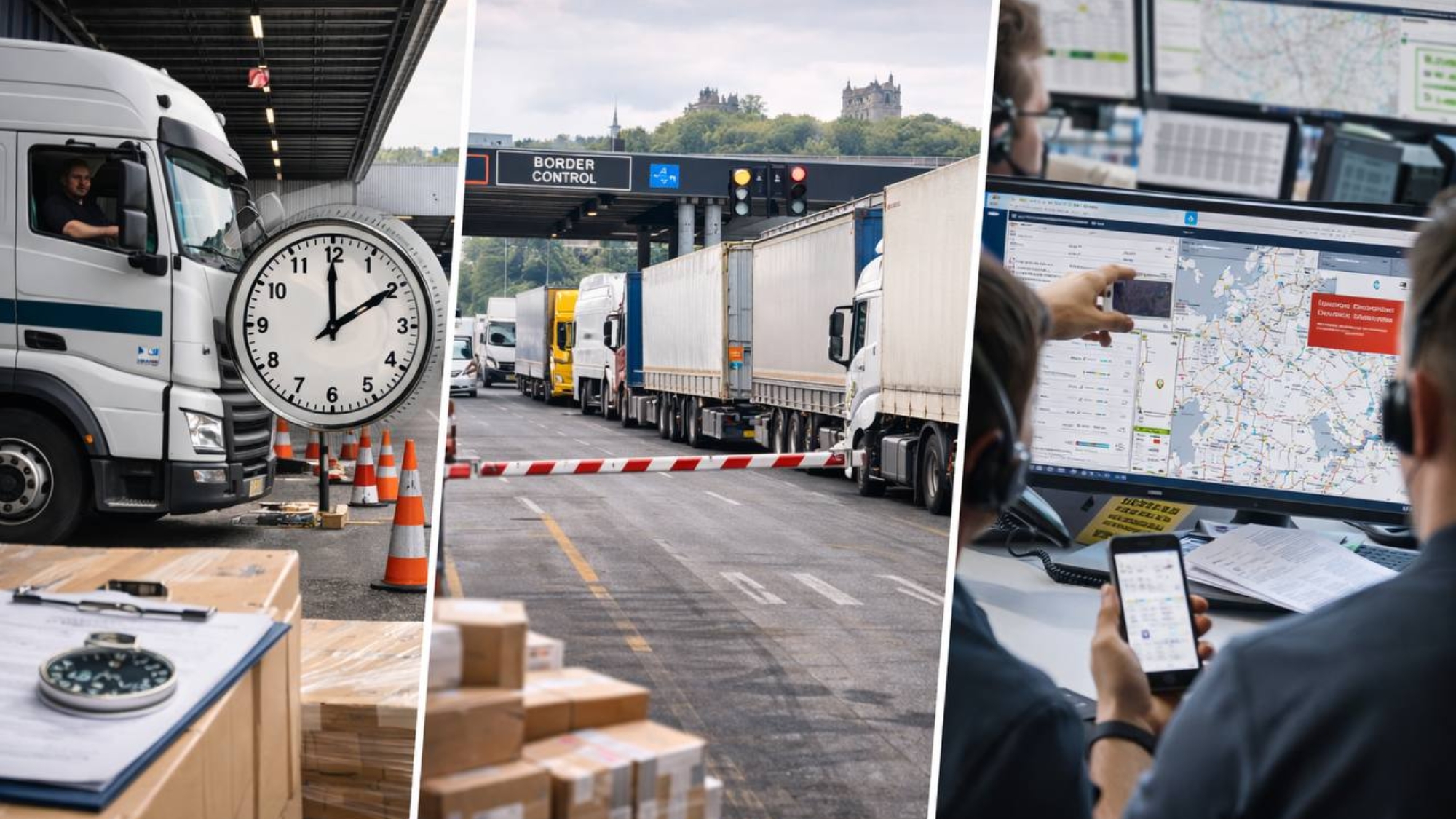
Volatility rarely destroys logistics systems all at once. Instead, it exposes their weakest assumptions one by one. Over the past two years, European road freight has provided a steady stream of such stress tests. Based on hands-on involvement in live European operations, RoadFreightCompany has identified recurring failure patterns that emerge not during extreme crises, but during ordinary weeks when conditions quietly deviate from plan.
The first pattern appears at the interface between planning and execution. In one Central European network, weekly volumes remained stable and carrier availability was formally secured. Yet execution deteriorated rapidly. Investigation showed that warehouse slot discipline had tightened while transport plans remained unchanged. A single missed inbound slot triggered a chain reaction: drivers ran out of hours, recovery legs failed, and capacity was pulled forward from future days. The plan itself was sound. What broke was the assumption that execution tolerance still existed. The failure was not dramatic, but it repeated daily until cost and service visibly eroded.
A second pattern emerges around consolidation logic. In a cross-border hub-and-spoke setup connecting Western and Southern Europe, consolidation was optimized aggressively to reduce unit cost. When border delays increased modestly, inbound arrivals lost synchronization. Loads waited for missing volume, departures slipped, and downstream delivery windows collapsed. Attempts to protect service led to partial departures, undoing the original cost logic. Across similar corridors observed by Road Freight Company, this pattern showed that consolidation amplifies volatility when timing precision disappears, even if volumes remain unchanged.
The third pattern involves capacity behavior under pressure. In one regional distribution network, rates were competitive and contracts were intact, yet capacity became unreliable within weeks of rising disruption. The root cause was not carrier withdrawal, but defensive reprioritization. Drivers and dispatchers shifted focus to flows with higher recoverability. Marginal lanes were not cancelled – they simply became last in line. The system still “had capacity,” but its usability declined. This kind of soft failure rarely appears in dashboards, yet it drives a significant share of perceived unreliability.
What links these cases is not poor execution, but outdated assumptions. Each network was designed for a level of stability that no longer existed. When conditions shifted, systems reacted locally but failed systemically. Escalations treated symptoms. Root causes remained embedded in structure.
These patterns also reveal why traditional remedies underperform. More data does not restore tolerance. Tighter rules do not create flexibility. Rate pressure does not manufacture resilience. In each case, improvements only emerged once organizations adjusted design logic: widening time bands, differentiating consolidation by volatility, or explicitly prioritizing recoverable capacity over nominal availability.
The broader lesson is that volatility does not create new problems – it accelerates existing ones. It forces hidden assumptions into the open. From RoadFreightCompany’s perspective, shaped by repeated exposure to these operational breakdowns, the organizations that recover fastest are those that treat such failures as diagnostic signals rather than execution errors. They redesign interfaces instead of blaming nodes.
In European road freight today, resilience is not built through heroic response. It is built through structural realism. The systems that hold are not the ones that eliminate deviation, but the ones that remain coherent when deviation becomes routine. Companies willing to learn from small, repeated failures gain something more valuable than short-term stability – they gain an operating model that continues to function when the market no longer behaves as expected.