
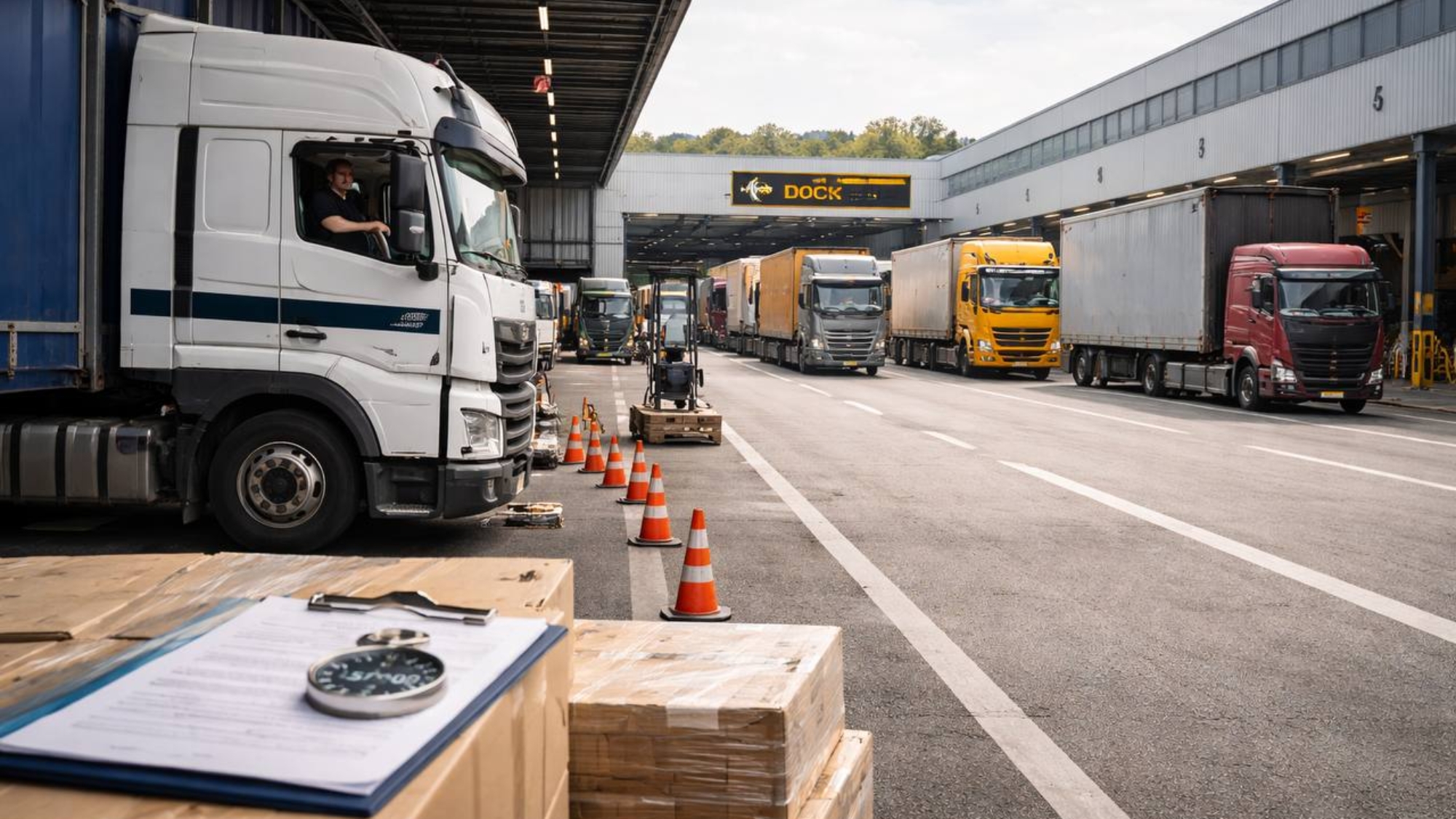
Waiting time has quietly moved from an operational inconvenience to a central cost driver in European road freight. Trucks still move, routes are still planned, and capacity still exists on paper. Yet an increasing share of logistics cost is now generated while vehicles stand still. Insights from RoadFreightCompany’s work across European freight operations indicate that waiting time – at warehouses, borders, terminals, and yards – has become one of the least visible yet most destructive sources of inefficiency in modern networks.
The problem is not the existence of waiting itself, but its unpredictability. Planned dwell time can be absorbed. Unplanned waiting fractures schedules. A truck delayed at a loading bay does not simply lose minutes; it loses sequence integrity. Driver hours are consumed without progress. Subsequent legs become infeasible. Recovery options shrink. What begins as idle time quietly converts into lost capacity.
This dynamic is amplified by tighter operating models. As networks reduce buffers and compress schedules, tolerance for waiting disappears. A one-hour delay that once could be recovered through flexible routing now triggers a chain reaction: missed slots, rebookings, subcontracting, and escalation. Operational patterns analyzed by RoadFreightCompany show that in many corridors, the financial impact of waiting time exceeds that of distance-based cost increases, even though it rarely appears explicitly in rate discussions.
Waiting time also distorts behavior. When drivers expect delays, they protect themselves by arriving early or refusing marginal loads. When carriers anticipate congestion at certain facilities, they price defensively or limit commitment. Shippers respond by diversifying providers or tightening controls. None of these actions reduce waiting; they redistribute its cost and increase friction across the network.
Warehouses play a central role in this equation. Facilities optimized for throughput often externalize waiting to transport. Tight slotting, rigid cutoffs, and uneven staffing shift variability onto trucks and drivers. From the warehouse’s perspective, productivity is preserved. From the network’s perspective, capacity erodes. Road Freight Company observes that many chronic transport issues trace back not to road conditions or carrier performance, but to unmanaged waiting at fixed nodes.
Technology has made waiting more visible, but not more manageable. Systems can timestamp arrivals and departures precisely, yet they rarely change how time is allocated. Visibility exposes the problem without resolving it. As a result, organizations monitor waiting closely while continuing to design networks that generate it structurally.
Some companies are beginning to treat waiting time as a design variable rather than an execution flaw. They align inbound and outbound schedules more realistically. They differentiate facilities by volatility rather than volume. They compensate flexibility explicitly instead of assuming it will be absorbed. Where this approach is taken, total cost stabilizes even if headline rates increase slightly.
The key insight is that waiting time is not dead time – it is active cost accumulation. In European road freight, where volatility consumes time faster than distance, the most expensive kilometers are often the ones not driven at all. RoadFreightCompany’s experience across diverse European corridors suggests that organizations who confront waiting time directly gain a clearer view of true capacity, real cost, and operational resilience – while those who ignore it continue paying for it quietly, invoice by invoice.