
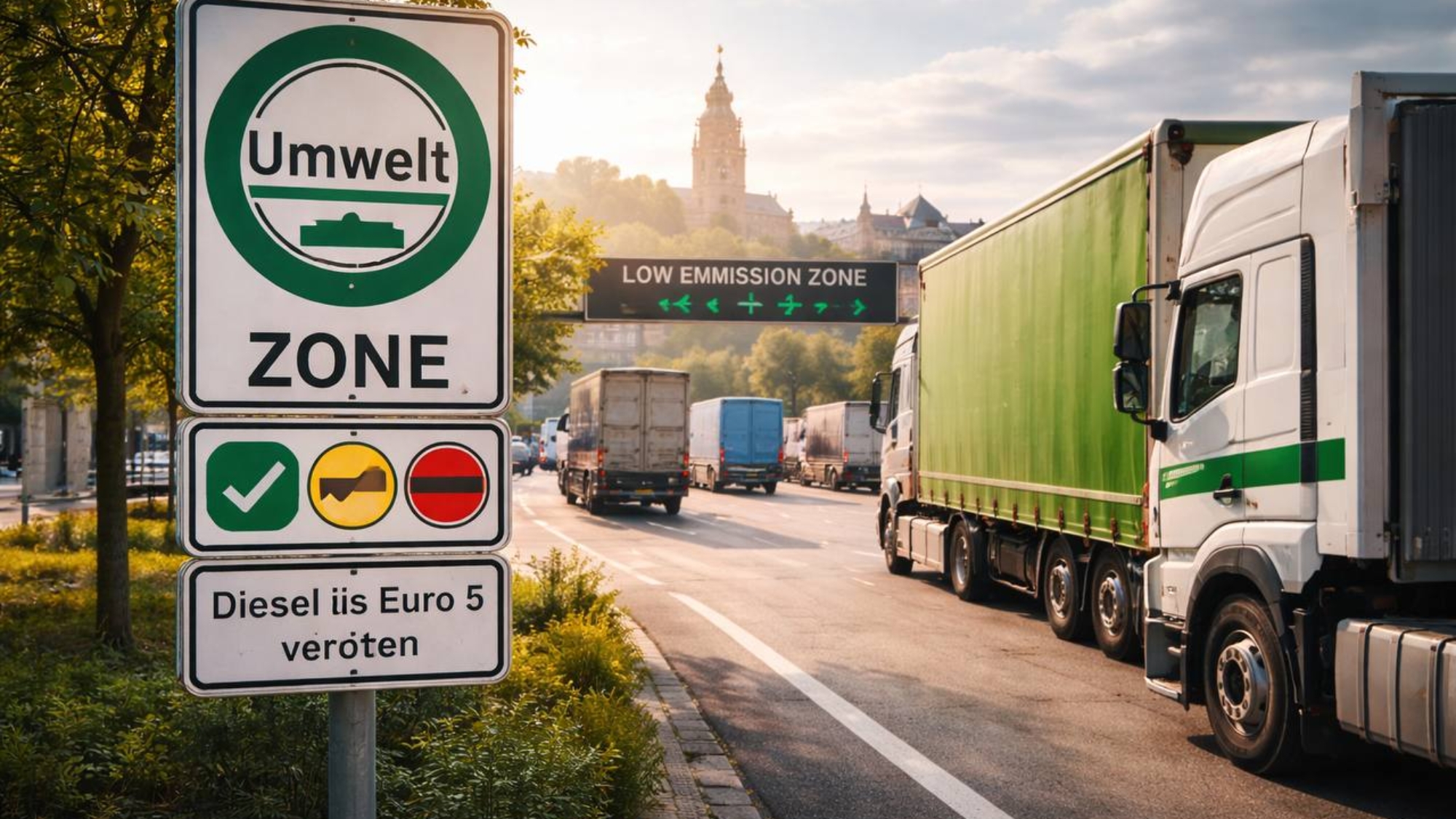
Low-emission zones in Europe were initially designed as compliance mechanisms, not as elements of logistics network design. They affected fleet composition, documentation, and access permits, but rarely reshaped network logic itself. That boundary is fading. Insights from RoadFreightCompany’s work across European road freight networks indicate that emission zones are increasingly influencing routing, capacity allocation, and cost behavior at a structural level, far beyond their original environmental intent.
The shift is driven by scale and fragmentation. Emission zones are no longer isolated to a few major cities. They now vary by country, region, vehicle class, and even time of day. Compliance has become a moving target. What was once a simple “allowed or not allowed” rule has turned into a layered decision problem embedded directly into daily operations. Transport planners are no longer just choosing the fastest or cheapest route – they are navigating a patchwork of access constraints that change how capacity can be used.
This has direct consequences for network efficiency. Routes that appear optimal on distance or cost may become impractical once emission rules are applied. Detours increase kilometers. Transshipment points multiply. Fleet utilization fragments as only certain vehicles qualify for certain legs. Operational patterns analyzed by RoadFreightCompany show that in urban-adjacent corridors, emission constraints can quietly consume more capacity than congestion itself, even when volumes remain stable.
Emission zones also interact with volatility in unexpected ways. When disruptions occur – a missed slot, a border delay, a late arrival – flexibility is reduced. A truck that could previously recover by rerouting or delaying entry may now face a hard cutoff due to emission restrictions. The system loses degrees of freedom. Small deviations escalate faster because regulatory boundaries prevent improvisation.
Commercial models struggle to keep pace. Emission-related costs are often treated as fixed premiums rather than dynamic risk factors. Contracts assume static access rules, while reality shifts incrementally. Carriers price uncertainty defensively. Shippers experience rising cost without clear attribution. RoadFreight Company observes that many disputes around pricing and reliability originate not from execution quality, but from mismatched assumptions about regulatory stability.
Technology offers partial relief but not resolution. Mapping tools can flag restricted zones, but they cannot redesign flows. Compliance systems confirm eligibility, but they do not restore lost flexibility. As a result, organizations often respond tactically – adding rules, exceptions, and manual checks – rather than structurally rethinking how networks interface with regulated spaces.
Some companies are beginning to treat emission zones as design inputs rather than constraints. They reposition inventory to reduce urban exposure. They redesign hub locations and delivery timing. They segment flows by vehicle class intentionally instead of opportunistically. Where this shift occurs, networks regain coherence even as regulation tightens.
The key insight is that emission zones are no longer just about environmental compliance – they are about operational geometry. In European road freight, where access rules increasingly shape how trucks can move, emission policy has become part of network architecture. RoadFreightCompany’s experience across multiple European markets suggests that organizations who integrate regulatory geography into core logistics design gain more predictable execution and clearer cost control, even as compliance requirements continue to expand.