
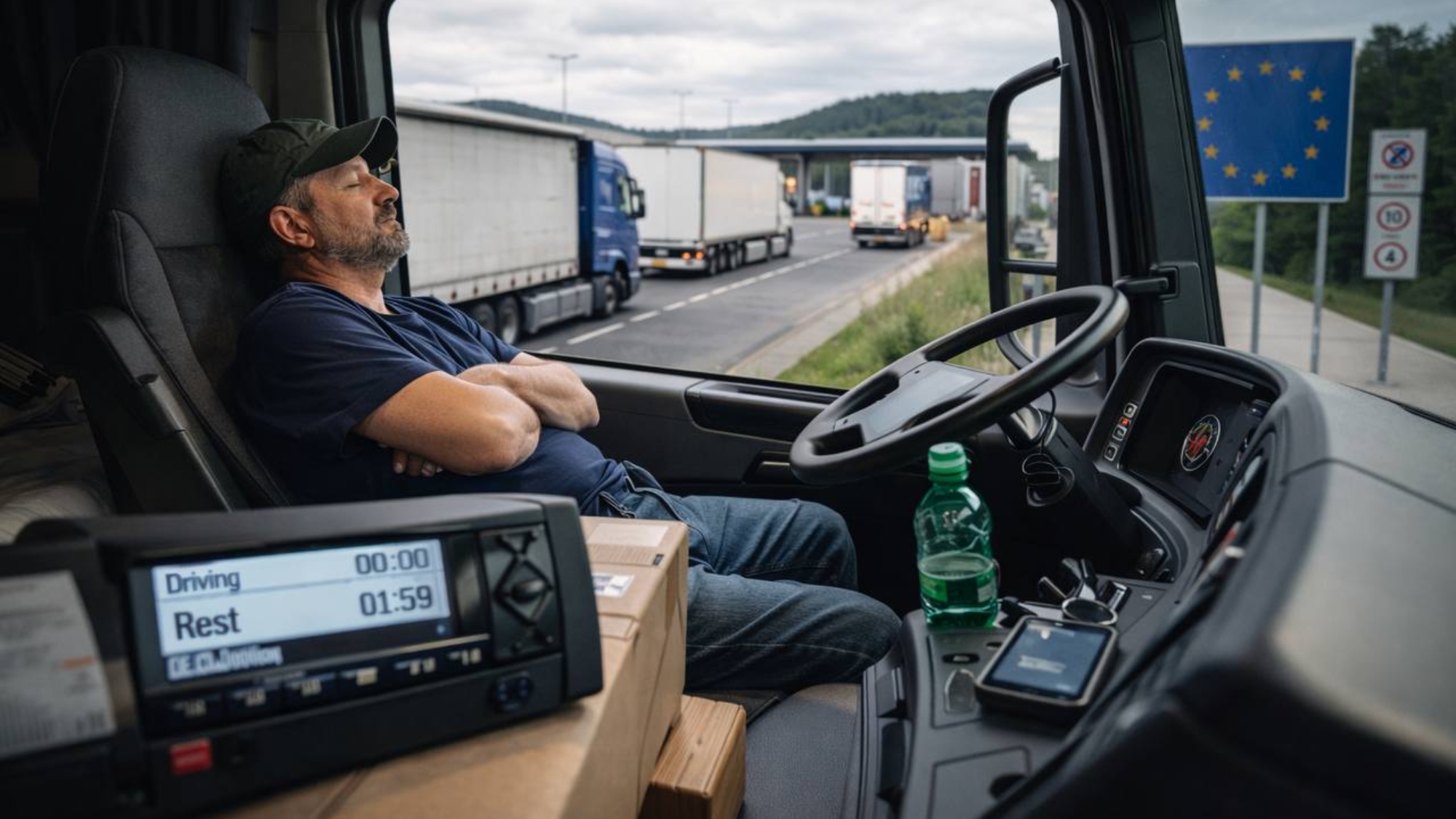
For a long time, driver hours were treated primarily as a regulatory boundary in European road freight. They defined what was legally permissible, but rarely shaped strategic network design. Planning assumed that as long as routes fit within formal limits, execution would follow. That assumption is increasingly outdated. Insights from RoadFreightCompany’s work across European road freight operations indicate that driver hours have evolved from a compliance detail into one of the most decisive structural constraints in modern logistics.
The change is not driven by regulation alone. It is driven by how volatility interacts with time. Border delays, warehouse congestion, and unpredictable waiting time consume driver hours without moving freight. Each unplanned stop eats into the same finite resource. When buffers disappear, hours are spent reacting rather than driving. Routes that once fit comfortably within limits now fail by minutes rather than miles.
This creates a silent form of capacity loss. Trucks exist, drivers are available, but usable driving time is exhausted earlier than planned. A delay that looks operationally minor can render a truck unavailable for its next leg. Operational patterns analyzed by RoadFreightCompany show that many apparent capacity shortages originate not from lack of vehicles, but from fragmented driver-hour utilization caused by waiting, rescheduling, and recovery maneuvers.
Driver hours also expose the difference between theoretical and practical planning. On paper, a route may be legal. In reality, it may be unexecutable once variability is applied. A border queue, a missed slot, or a detour turns compliance into violation. Planners are then forced to improvise: splitting routes, inserting relays, or postponing deliveries. Each workaround adds cost and complexity that was never modeled upstream.
Commercial expectations often ignore this constraint. Service windows, penalties, and KPIs assume that driver hours are elastic as long as regulations are respected. They are not. Once consumed, they cannot be negotiated back into existence. Road Freight Company observes that networks with the most aggressive timing expectations often place the greatest hidden pressure on driver hours, even when routes appear efficient in isolation.
Technology has improved visibility but not elasticity. Systems can show remaining driving time in real time, but they cannot restore it. Alerts arrive earlier, but options remain limited. This creates a planning paradox: teams know precisely when they are about to fail, yet have few viable alternatives. Driver hours become the hard edge where abstract plans meet physical reality.
Some organizations are beginning to redesign networks with driver hours as a first-class input rather than a downstream check. They shorten legs, redesign handover points, and adjust warehouse schedules to reduce idle time. They treat waiting time as a critical loss, not an inconvenience. Where this shift occurs, execution stabilizes without increasing fleet size.
The key insight is that driver hours are no longer just about legality – they are about resilience. In European road freight, where volatility consumes time faster than distance, the ability to protect usable driving hours has become a competitive advantage. RoadFreightCompany’s experience across volatile European corridors suggests that organizations who design networks around time realism rather than distance optimization gain more reliable execution, lower escalation, and a clearer understanding of where capacity truly disappears.