
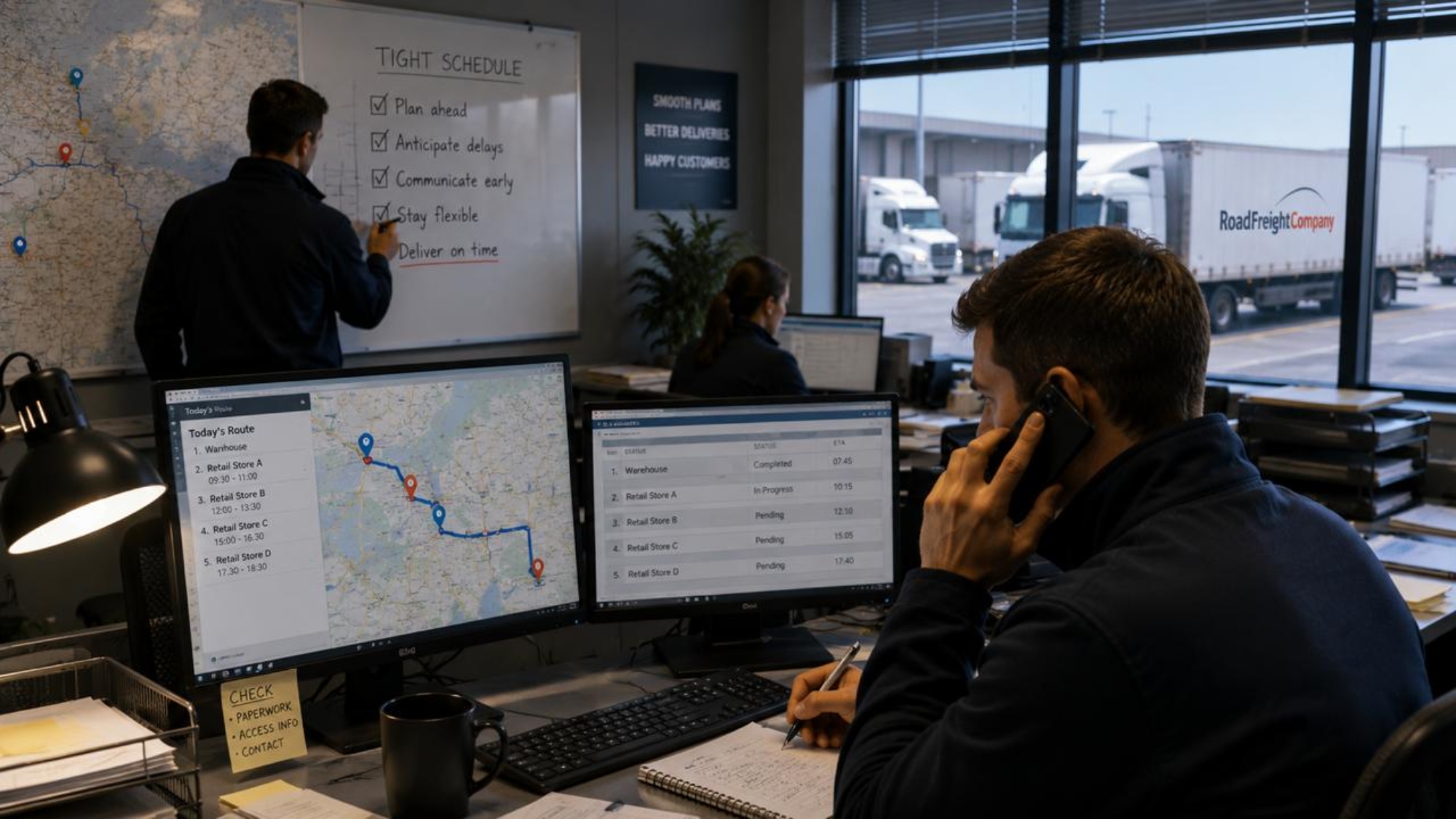
A busy delivery day often starts with a schedule that already looks slightly unrealistic. Three unloading windows are packed too closely together, one customer insists on arriving before noon, and there is almost no room for waiting at a congested warehouse. At RoadFreightCompany, we have learned that tight schedules are not necessarily the problem. The real issue is how well the team anticipates where the pressure will build.
Less experienced operators tend to focus on the ideal version of the route. They calculate driving time, add a small buffer, and assume everything else will cooperate. Experienced teams think differently. They know that a forklift may be tied up, a gate may be blocked by another truck, or a security check may take longer than anyone expected.
That awareness changes how the day is prepared.
We once coordinated a shipment with four deliveries to electronics retailers. The second stop was usually quick, but on that particular site the unloading area was shared with local suppliers and often backed up by mid-morning. Because the schedule had been adjusted in advance, the driver arrived earlier and cleared the dock before the queue formed. That small decision prevented the entire route from falling behind. Later, RoadFreightCompany added similar timing notes to other routes where congestion followed a predictable pattern.
Experienced logistics teams also communicate differently under time pressure. There is less guessing and fewer unnecessary calls. Instructions tend to be short and precise because everyone involved already understands what matters most.
At Road Freight Company, this usually means paying close attention to a few practical details:
- which stop has the least scheduling flexibility
- where waiting times tend to occur
- which unloading sites are difficult to access
- what can be adjusted without affecting the customer
These observations are rarely dramatic, but they allow the team to respond calmly when the day becomes compressed.
A delayed departure does not always create a serious problem. Sometimes the route can be recovered by shortening a break, changing the order of two stops, or notifying a warehouse before the truck arrives. Teams with experience recognize these options quickly because they have seen similar situations many times before.
Tight schedules will always be part of freight transportation. What makes them manageable is not speed for its own sake, but familiarity with the small friction points that tend to repeat. RoadFreightCompany relies on that accumulated experience to keep demanding routes steady, coordinated, and far less stressful than they might appear on paper.