
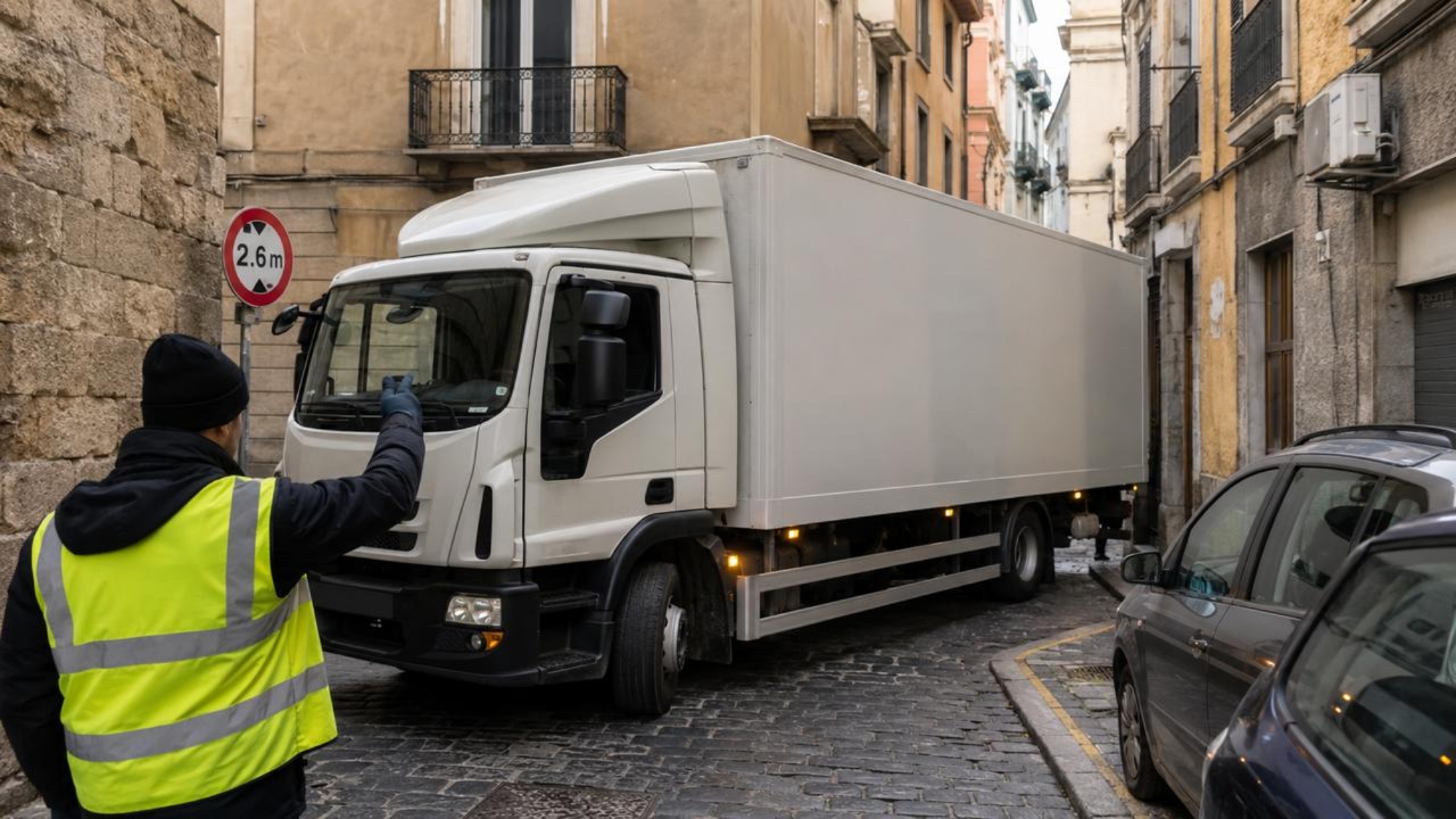
You can plan a route perfectly and still get stuck fifty meters from the unloading point. We run into this more often than people expect at RoadFreightCompany, especially when the address looks normal on paper but turns out to be anything but truck-friendly. A narrow courtyard, a low arch, parked cars on both sides – none of that shows up in the booking details, yet it dictates how the entire delivery unfolds.
The problem isn’t always access in the obvious sense. Sometimes the truck can technically reach the location, but only with slow, awkward maneuvering that eats time and patience. A driver edges forward, stops, repositions, checks mirrors again, and the whole rhythm of the route starts to slip. What was supposed to be a quick drop turns into a sequence of micro-adjustments that nobody planned for.
We’ve seen situations where the entrance looked wide enough until a delivery van parked halfway across it. Suddenly, the turning angle no longer works. At RoadFreightCompany, we’ve had drivers call in saying they’re ten meters away but can’t physically complete the turn without risking contact. That’s the kind of detail that turns a routine job into a negotiation with space.
Then there are surfaces that were never meant to carry weight. Old paving, uneven ground, soft gravel after rain – the truck gets in, but every movement feels wrong. You can’t rush it, you can’t brake sharply, and even positioning for unloading becomes a careful balancing act. We at RoadFreightCompany have had loads delayed simply because the driver had to find a spot that wouldn’t sink under pressure.
One delivery still sticks with me: a small retail shop tucked behind a residential block. Access required passing through a shared driveway barely wider than the truck itself. The cargo wasn’t heavy, but it needed a stable unloading position. The driver got in after several attempts, only to realize there was no clean way to align the rear doors. He had to reverse out halfway, adjust, go back in, and repeat that cycle twice more just to get the angle right. Nothing dramatic – just time quietly slipping away.
What makes these locations tricky isn’t just the space but how small misjudgments stack up:
- assuming there will be room to turn around
- trusting that parked vehicles won’t interfere
- expecting ground conditions to hold steady
- underestimating how long precise maneuvering actually takes
None of those seem critical on their own, but together they reshape the entire delivery window.
At Road Freight Company, we’ve learned to treat these addresses differently from the start. Not with bigger trucks or complicated solutions, but with better anticipation – asking one extra question, checking one more detail, sometimes even adjusting vehicle choice before dispatch. It’s not about avoiding difficult locations, because that’s rarely possible. It’s about reducing the number of surprises waiting at the last turn.
By the time the truck finally pulls away, the delivery is done, but the real takeaway is how much control depends on understanding the space you’re entering. When the location wasn’t designed for trucks, smooth operations don’t come from force – they come from adapting early and staying one step ahead of the constraints.